Engineering Chemistry

Chapter 7: Chemical Kinetics

7.1 RATE OF A CHEMICAL REACTION

The rate of a reaction tells us at what speed the reaction occurs. It may bedefined as the change in concentration of any one of the reactants or products per unit time. Consider a simple reaction


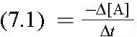
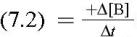
The rate of the reaction may be expressed as:


Where ?[A] represents decrease in the concentration of A in molL ?1, ?[B] represents increase in concentration of B in molL ?1.

7.2 AVERAGE AND INSTANTANEOUS RATE OF A REACTION

The rate expression given in preceding equations (7.1) and (7.2) are averagerate of reactions over the time interval ( ? t). Average rate may be expressed as:


As the reaction proceeds, the concentration of the reactants keep on decreasing rapidly in the initial stages and more slowly later on. Thus the rate of reaction may not be constant in the time interval and therefore it cannot be determined simply by dividing the total change in the concentration by the time taken. The rate of reaction may be expressed at a particular moment of time as the rate of change of concentration of any one of the reactants or products at a given time. Such reaction rate is called instantaneous rate. For this purpose the time interval ? t is made as small as possible so that the rate of reaction remains almost constant during that time interval.

Mathematically, instantaneous rates may be represented as or instead of

UNLIMITED FREE
ACCESS
TO THE WORLD'S BEST IDEAS

SUBMIT
Already a GlobalSpec user? Log in.

This is embarrasing...

An error occurred while processing the form. Please try again in a few minutes.

Customize Your GlobalSpec Experience

Category: Catalysts and Initiators
Finish!
Privacy Policy

This is embarrasing...

An error occurred while processing the form. Please try again in a few minutes.