Engineering Chemistry

Electrochemistry studies the relationship between chemical and electrical phenomena and the laws of their interaction. Such interactions are observed at the boundaries between electrolytes and electrodes dipping in them.
Electrochemistry is of great significance, since the laws of electrochemistry forms the basis of technical processes like electrolysis and electrosynthesis. The branch holds importance for a number of reasons:
It is of huge economical importance because of the costly destruction caused by corrosion and the possibilities of fuel cells which generate electricity directly from fuel.
It provides techniques for measuring the thermodynamical state functions and for predicting equilibrium concentrations of dissolving and reacting ions.
Thus the branch of electrochemistry is of major technological importance.
An electrochemical cell is a single arrangement of two electrodes and an electrolyte for producing an electric current due to chemical action within the cell, or for producing chemical action due to passage of electricity. Thus electrochemical cells may be used for two purposes.
to convert chemical energy into electrical energy.
to convert electrical energy into chemical energy.
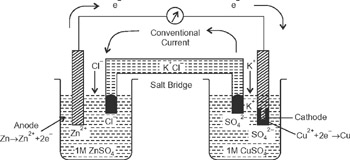
A galvanic cell, also known as voltaic cell, is a device in which electrical current is generated by a spontaneous redox reaction. A simple voltaic cell is shown in Figure 6.1 and the reaction taking place is:
A bar of zinc metal (anode) is placed in zinc sulphate solution in the left container. A bar of copper (cathode) is immersed in a...