16.4 EXPERIMENTS
Experiment No. 1. To determine the constituents and amount of alkalinity in the supplied water sample.
Theory: The alkalinity is the quantitative ability of water to react with a strong acid at a designated pH. It is primarily a function of carbonate, bicarbonate and hydroxide content. Alkalinity in natural waters is due to free hydrolysis and hydrolysis of salts formed by weak acids and strong bases.
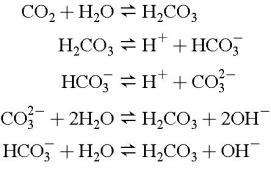
Most of the alkalinity in natural water is formed due to dissolution of CO 2 in water. Carbonates and bicarbonates thus formed are dissolved to yield hydroxyl ions.
Therefore, the total alkalinity (TA) of the system is due to
Thus, the alkalinity of water is mainly due to hydroxides, carbonates and bicarbonates. The following possibilities may arise with respect to the constituents causing alkalinity in natural waters:
-
Hydroxides only
-
Carbonates only
-
Bicarbonates only
-
Hydroxide and carbonates only
-
Carbonates and bicarbonates.
Hydroxides and bicarbonates cannot exist together as they combine with each other to form carbonates.
The type and extent of alkalinity present in a water sample can be determined by titrating the sample with a standard solution of acid using phenolphthalein (P) and methyl orange (M) indicators.
The volume of acid run-down for phenolphthalein (phe) end point, P mL, corresponds to the completion of equations (i) and (ii) while the volume of acid run-down after P mL corresponds to the completion of equation (iii).
The total amount of acid used from the beginning of the experiment, i.e., (M)...

 TABLE OF CONTENTS