4.1 BECKMANN REARRANGEMENT
Beckmann rearrangement and Hoffmann rearrangement involve migration of an alkyl or aryl group with its bonding pair of electrons from the carbon atom to the adjacent nitrogen atom.
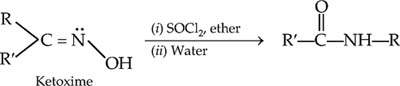
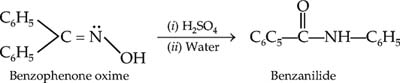
When ketoximes and aldoximes are treated with acidic reagents such as conc. H 2SO 4, PCl 5, P 2O 5, SOCl 2, SO 3, C 6H 5SO 2Cl and polyphosphoric acid (PPA), they rearrange to form a corresponding amide. This is known as Beckmann's rearrangement. For example,
-
-
-

-

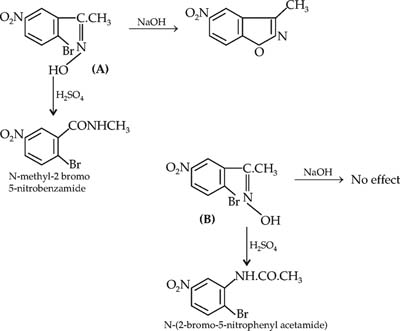
Beckmann's rearrangement is stereospecific in nature and the alkyl or aryl group anti-to the oxime hydroxyl group migrates preferentially. The anti-migration of the group was demonstrated by Meisenheimer by the following experiment:
Meisenheimer, in 1924 and 1926 showed that one of the isomer of 2-bromo-5-nitro acetophenone oxime was unaffected by sodium hydroxide whereas the other undergoes ring closure to form 3-methyl-5-nitro benzisoxazole, proving that, in the latter reacting groups, ?OH and ?Br are close together and hence it can be represented by the configuration (A), whereas the other is represented by (B).
When the two above oximes (A) and (B) of known configuration are treated with acidic reagents, oxime (A) yields a substituted N-methyl benzamide whereas the B yields N-substituted benzamide, favoring migration of the anti-group.
Mechanism. The Beckmann rearrangement does not proceed by an intramolecular exchange of hydroxyl and phenyl groups. The mechanism involves the formation of a protonated oxime by the action of...


 TABLE OF CONTENTS