Engineering Chemistry

The soap consuming capacity of water is known as the hardness of water. It is generally caused by calcium and magnesium ions present in water. Polyvalent ions of metals like strontium, iron, aluminium, zinc, and manganese etc., are also capable of precipitating the soap and thus contribute to hardness. However, the concentration of these ions is very low in natural waters, therefore hardness is generally measured as a concentration of only calcium and magnesium ions as calcium carbonate.
The water hardness may be classified as:
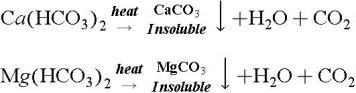
Temporary hardness. The hardness that can be removed by boiling the water is called temporary hardness. It is caused by the presence of bicarbonates of calcium and magnesium. On boiling, bicarbonates are decomposed into insoluble carbonates.
The insoluble carbonates can be easily removed by filtration. Thus, boiling not only removes Ca 2+ and Mg 2+ ions but also decreases the total ionic content of the water.
Permanent hardness. This is due to the presence of sulphates, chlorides, and nitrates of calcium, magnesium, and other metals and cannot be removed by boiling.
The hardness is determined by EDTA method. Calcium and magnesium form a complex of wine red color with EBT (Eriochrome black-T) at p H 10 0.1. The EDTA (Ethylene diamine tetracetic acid) has stronger affinity for Ca 2+ and Mg 2+ ions, and therefore by addition of EDTA, the blue color of the indicator...