Engineering Chemistry

| 1. | Name the forms in which the chlorides are present in water. |
|
| 2. | How can you determine the chloride content in water? |
|
| 3. | What is Mohr's method for the determination of chloride ions in a water sample? |
|
| 4. | Write the reactions involved in Mohr's method. |
|
| 5. | Name the indicator used in this experiment. |
|
| 6. | At what pH can you determined the chloride ion in the given water sample? |
|
| 7. | What is the other name of this method? |
|
| 8. | What is the optimum pH for the experiment? |
|
| 9. | What are precipitation titrations? |
|
| 10. | What are the indicators used in precipitation titrations? |
|
| 11. | How can the required pH for the experiment be achieved if it is lower than 7? |
|
| 12. | What is the significance of Cl ? ion determination? |
|
Answers
| 1. | Chlorides are present in water as NaCl, MgCl 2 and CaCl 2. |
| 2. | The chloride content in a water sample can be determined by Mohr's method. |
| 3. | In Mohr's method, the given water sample is titrated against standard AgNO 3 solution using potassium chromate as an indicator. |
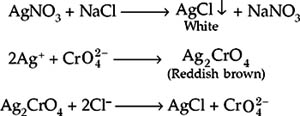
| 4. |
![]() |
| 5. | Potassium chromate is used as indicator. |
| 6. | For chloride ion determination, the water sample should be neutral or faintly alkaline because Ag 2CrO 4 is readily soluble in acidic medium. |
| 7. | Argentometric method. |
| 8. | The reaction should be carried out at pH 7 to 10. |
| 9. | The titrations accompanied by the formation of sparingly soluble salts, when the... |