More Practical Filters and Couplers: A Collection from Applied Microwave & Wireless
With additional articles on filter and coupler design, this collection focuses on tunable structures and couplers.
 TABLE OF CONTENTS
 By Randy Rhea
From APPLIED MICROWAVE & WIRELESS, VOL. 13, NO. 1, JANUARY 2001
More economic and effective band-pass filters can be designed by controlling the location of transmission zeros. What do we mean by transmission zeros? Consider the fifth-order low-pass filter in Figure 1a. There is little attenuation at low frequencies and increasing attenuation above the cutoff. Only at infinite frequency is there no transmission. In fact, at infinite frequency, each inductor becomes an open and each capacitor becomes a short. This filter has five transmission zeros (TZs) at infinite frequency. The fifth order highpass filter in Figure 1b has five TZs at DC.
It is essential that the inductors and capacitors alternate. If we were to build a fifth-order low-pass with five series inductors, we would have only one inductor whose inductance is the total of the five series inductors: this is only a first order filter. A similar effect occurs if all elements are shunt capacitors. The discovery by Cambell in the U.S. and Wegner in Germany in 1915 that elements or resonators must alternate was the beginning of filter theory.
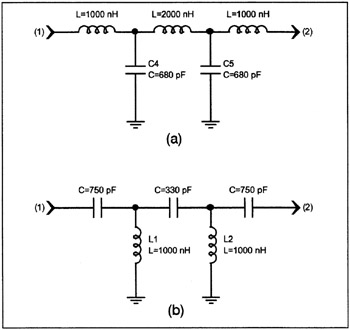
Recognizing the number of TZs is more interesting with band-pass filters. Consider the conventional third-order band-pass in Figure 2(a). At DC (B), the series inductors and the shunt capacitor have no effect they vanish. There are three TZs at DC. At infinity (C), the series capacitors and...