More Practical Filters and Couplers: A Collection from Applied Microwave & Wireless
With additional articles on filter and coupler design, this collection focuses on tunable structures and couplers.
 TABLE OF CONTENTS
 One drawback of TE111 cavity filters is that two simultaneous orthogonal modes can be excited. The unintended second mode can cause spurious absorption notches in the pass-band, presenting the designer with two options. The second mode either can be eliminated, resulting in a single-mode filter, or it can be put to advantage, in a dual-mode filter.
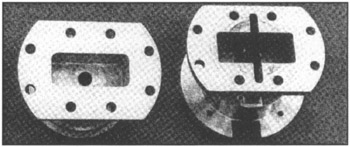
In a single mode filter the orthogonal mode is eliminated in the pass-band through either of two methods. In the first, the filters are designed to operate with sufficient tuning screw penetration to split the resonant frequencies, thereby tuning the undesired resonant mode above the pass-band. With the second, mode suppressors are employed in each end of the filter to absorb any residual orthogonal mode energy without significantly affecting the operating mode [9], Figure 4 shows one of the end sections of a filter containing a mode suppressor.
In a dual mode filter, the orthogonal modes are coupled within the same cavity by means of a 45 degree tuning screw located at the mid plane. The coupling between individual cavities is similar to the single mode situation. Since both modes are utilized for this type of filter, each physical cavity actually represents two filter sections (i.e., number of cavities=N/2 for dual-mode, whereas number of cavities=N for single-mode, where N represents the number of filter elements and corresponds to the same N in the response equations discussed earlier...