More Practical Filters and Couplers: A Collection from Applied Microwave & Wireless
With additional articles on filter and coupler design, this collection focuses on tunable structures and couplers.
 TABLE OF CONTENTS
 The TE111 cylindrical cavity mode provides good mode separation, small size, and an unloaded Q which is greater than that of comparable volume rectangular cavities. However, cavities which support higher order modes can also be considered. Physically larger cavities can provide even higher unloaded Q s and thus lower insertion loss, but a greater density of spurious modes will result from this choice.
The resonant modes that can be formed using the ten lowest cutoff frequency circular waveguide modes were systematically searched with a computer routine [4]. This routine calculates the cut-off frequency of several modes for a given waveguide dimension, either circular or rectangular.
Minimum mode separation was set at 5 percent. Resonances which did not provide a significant unloaded Q improvement over the TE111 case for the increased size were rejected. The candidate modes that survived the screening are shown in Figure 3.
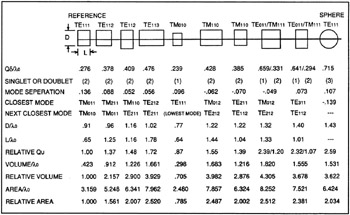
The TE011 mode offers the greatest improvement in Qu for cylindrical shapes but is degenerate with the TM111 mode, which has a lower Qu. The TE1m1 sphere resonance yields an even higher unloaded Q but has a three fold degeneracy. Using these configurations increases the design complexity, since the extraneous modes must be moved out of the band. Degenerate modes can be used such that a dual or triple mode filter results [4].
Although it has been demonstrated that for higher order mode cavities, a Qu of two and...