Principles of Turbomachinery in Air-Breathing Engines

Chapter One: Introduction to Gas-Turbine Engines

Definition

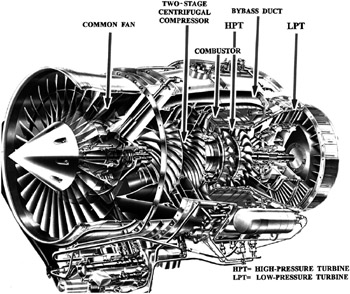
A gas turbine engine is a device that is designed to convert the thermal energy of a fuel into some form of useful power, such as mechanical (or shaft) power or a high-speed thrust of a jet. The engine consists, basically, of a gas generator and a power-conversion section, as shown in Figures 1.1 and 1.2.


Figure 1.1: Example of an auxiliary power unit. GTCP 660-4 Auxiliary power unit (Garrett Turbine Engine Co.).

Figure 1.2: Example of a turboshaft system. TPE 331 14 Turboprop engine (Allied-Signal Technologies).

As is clear in these figures, the gas generator consists of the compressor, combustor, and turbine sections. In this assembly, the turbine extracts shaft power to at least drive the compressor, which is the case of a turbojet. Typically, in most other applications, the turbine will extract more shaft work by comparison. The excess amount in this case will be transmitted to a ducted fan (turbofan engine) or a propeller (turboprop engine), as seen in Figure 1.2. However, the shaft work may also be utilized in supplying direct shaft work, or producing electricity in the case of a power plant or an auxiliary power unit (Fig. 1.1). The fact, in light of Figures 1.1 through 1.5, is that different types of gas-turbine engines clearly result from adding various inlet and exit components, to the gas generator. An always interesting component in this context is the thrust-augmentation devices known as afterburners in a special class of advanced propulsion systems (Fig. 1.4).


Figure...

UNLIMITED FREE
ACCESS
TO THE WORLD'S BEST IDEAS

SUBMIT
Already a GlobalSpec user? Log in.

This is embarrasing...

An error occurred while processing the form. Please try again in a few minutes.

Customize Your GlobalSpec Experience

Category: Auxiliary Power Units (APU)
Finish!
Privacy Policy

This is embarrasing...

An error occurred while processing the form. Please try again in a few minutes.