In Chapters 3 and 4, we studied major changes in the thermophysical properties of a flow as it traverses a turbine or compressor stage. The analysis then was one-dimensional, with the underlying assumption that average flow properties will prevail midway between the endwalls. Categorized as a pitch-line flow model, this bulk-flow analysis proceeds along the master streamline (or pitch line), with no attention given to any lateral flow-property gradients.
However, we know of, at least, one radius-dependent variable, namely the tangential solid-body velocity vector ( U). The question addressed in this chapter is how the other thermophysical properties vary along the local annulus height at any streamwise location. The stator and rotor inlet and exit stations, being important control locations, are particularly important in this context. In the following, the so-called radial equilibrium equation is derived and specific simple solutions offered. Despite the flow-model simplicity, the radial-equilibrium equation enables the designer early on to take a look at preliminary magnitudes of such important variables as the hub and tip reactions prior to the detailed design phase.
Assumptions
For any axial stator-to-rotor or interstage gap in Figure 6.1, the following assumptions are made:
-
The flow is under a steady-state condition.
-
The flow is inviscid as well as adiabatic.
-
The flow is axisymmetric (i.e., ?-independent).
-
There are no radial shifts of the meridional streamlines (Fig. 6.2).
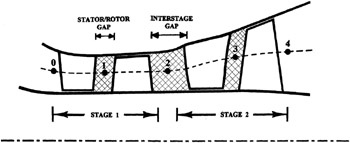 Figure 6.1: Stator/rotor and interstage gaps in a two-stage turbine.
 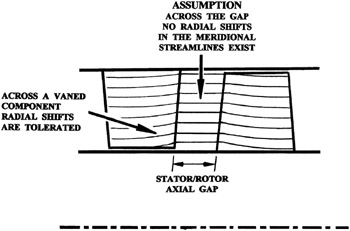 Figure 6.2: Radial shifts of the meridional streamlines within the...
Copyright Erian A. Baskharone 2006 under license agreement with Books24x7


 TABLE OF CONTENTS