Principles of Turbomachinery in Air-Breathing Engines

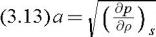
The propagation speed of a sound wave in any fluid is referred to as the sonic speed a and is defined as
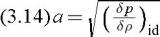
The subscript s in equation (3.13) refers to the fact that the change in applied pressure and the resulting change in density will have to be within a fixed-entropy (i.e., isentropic) process. In practical terms, and in light of expression (3.13) one could achieve a rough estimate of the sonic speed by enclosing the fluid, say, in an apparatus such as a well-insulated piston-cylinder device in which the surfaces moving relative to one another are highly polished in order to nearly eliminate friction effects. Two very close states of the fluid can then be allowed to slowly and gradually take place, whereby the applied pressure is slightly increased (relative to the initial-state pressure) and the new volume measured. Knowing the mass of the fluid, the density can be computed in both states. Finally, the small changes in pressure and density can be substituted in an approximate equivalent to expression (3.13) as follows:
In the preceding process description, you may have noticed that we were simply trying to come as close to an isentropic process as possible. As silly as it may appear, the foregoing exercise may help explain why the sonic speed in liquids can be exceedingly high. After all, no matter what the amount of pressure change might be, the density-change response of the liquid will be very small.