Principles of Turbomachinery in Air-Breathing Engines

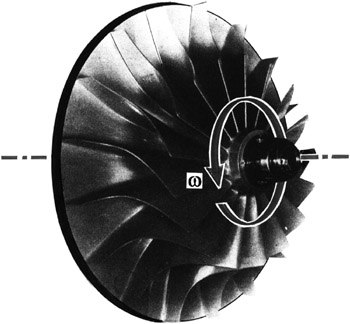
The utilization of axial-flow compressors (Fig. 9.1) in gas-turbine engines has been relatively recent. The history of this compressor type began following an era when centrifugal compressors (Fig. 9.2) were dominant. It was later confirmed, on an experimental basis, that axial-flow compressors can run much more efficiently. Earlier attempts to build multistage axial-flow compressors entailed running multistage axial-flow turbines in the reverse direction. As presented in Chapter 4, a compressor-stage reaction in this case will be negative, a situation that has its own performance-degradation effect. Today, carefully designed axial-flow compressor stages can very well have efficiencies in excess of 80%. A good part of this advancement is because of the standardization of thoughtfully devised compressor-cascade blading rules.
In passing through a reaction-turbine blade row, the flow stream will continually lose static pressure and enthalpy. The result is a corresponding rise in kinetic energy, making the process one of the flow-acceleration type. In axial compressors, by contrast, an unfavorable static pressure gradient prevails under which large-scale losses become more than likely. It is therefore sensible to take greater care in the compressor-blading phase. Another major difference, by reference to Figure 9.3, is that the compressor meridional flow path is geometrically converging as opposed to the typically diverging flow path of a turbine. This is a direct result of the streamwise density rise in this case, as will be discussed later. Referring to...