Principles of Turbomachinery in Air-Breathing Engines

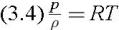
Under a sufficiently low (theoretically zero) pressure, a gas will behave ideally, whereby the so-called equation of state applies:
where R is referred to as the gas constant and is defined as
with R u referring to the universal gas constant [approximately 8315 J/(kMole K)] and M g being the gas molar mass (commonly known as the molecular weight).
It is appropriate at this point to stress a few important items that will influence the majority of numerical examples virtually everywhere in this text. These have to do with the nature of the working medium, its conformity to the ideal-gas simplification, and the general topic of numerical precision in this and later chapters.
Throughout a gas-turbine engine, the gas pressure will change so dramatically from an ambient magnitude at inlet to typically more than 10 atmospheres at the turbine s inlet station. Under a pressure limitation too theoretical for the gas to behave ideally, in this case, it would appear logical to use gas tables rather than the equation of state to obtain the appropriate magnitudes of thermodynamic properties. Despite how fitting this may be, it has been customary to employ the equation of state, even within high-pressure subdomains. Of course, this will always produce errors of varying magnitudes. The question, nevertheless, is whether a preliminary sizing designer, in particular, can live with these errors. Perhaps a numerical example (presented next in this section) can clarify this point from an engineering...