Principles of Turbomachinery in Air-Breathing Engines

As represented earlier, an ideal gas is one that is under an extremely small (ideally zero) static pressure. The thermodynamic state of the gas in this case is defined by only two independent properties. This is a result of the existence of a thermodynamic closure, namely the equation of state:
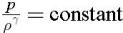
Assuming that the gas undergoes thermodynamic processes with sufficiently small-temperature processes, the specific-heat ratio ? can be treated as constant. Among such processes, let us consider in particular the isentropic process, which eventually leads to the sonic-speed definition. With the assumptions stated earlier, it is rather easy to prove that the path of the process is controlled by the following relationship:
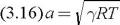
Differentiating this relationship, and invoking the equation of state, the sonic-speed expression (3.13) becomes
Examination of expression (3.16) reveals that the sonic speed in an ideal gas is a function of its static temperature only. Again, the fact should be emphasized that the sonic speed represents the compressibility of a working medium that is at rest.