Principles of Turbomachinery in Air-Breathing Engines

In this chapter, we will get familiar with a new and unique performance gauge that is independent of the size of a turbomachine (in terms of the total-to-total pressure ratio). In addition, we will have a means of computing the overall efficiency of several stages, particularly those sharing the same total-to-total magnitudes of pressure ratio and efficiency without having to resort to the thermodynamics of each individual stage. The point is made that adding more stages to a multistage turbomachine will have drastic, but totally opposite, effects on turbines as contrasted with compressors. We will prove through this exercise that adding more turbine stages enhances the performance of the final turbine configuration. The effect in compressors, however, is that of performance deterioration.
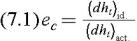
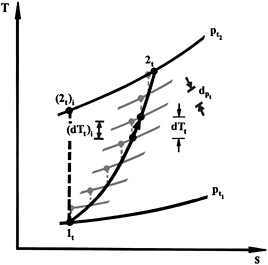
With no lack of generality, let us consider the stagewise compression process in Figure 7.1. Let us also view the process as a theoretically infinite sequence of compression processes over infinitesimally small compressor stages, as shown in the figure. The polytropic efficiency definition (to follow) applies to any of these stages. From such process increments, let us pick the segment that is highlighted in Figure 7.1. The polytropic efficiency is defined as
where the subscript c refers to compressor, the case at hand. Noting that the infinitesimally small process is one that, in the limit, tends to collapse around the average state, it is perhaps clear why e c is considered a state-dependent variable.