SS7 Basics, Second Edition

This guidebook provides an overview of SS7 technologies, how they are structured, and why they are important.
 TABLE OF CONTENTS
 The Signaling Connection Control Part (SCCP) offers enhancements to the MTP Level 3 to provide connectionless and connection-oriented network services, as well as to address translation capabilities. Figure 5.1 shows the SCCP enhancements to the MTP services provide a network service that is equivalent to the OSI Network Layer 3.
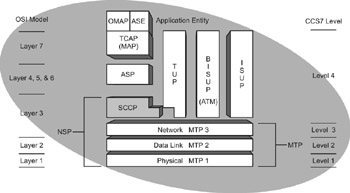
The routing capability of the MTP is limited to delivering messages to the correct signaling point based on the destination point code (DPC). After receiving the message, it is forwarded to the correct MTP user within the signaling point based on the value of the service indicator contained within the signal information octet.
The SCCP provides an additional global title address translation function. A global title is an address, such as dialed digits for voice, data, ISDN or mobile networks, which cannot be routed on directly. The SCCP translates this number into a DPC and a sub-system number (SSN). The SSN identifies the SCCP user at a signaling point. Examples of SCCP users include SCCP management, ISDN-UP, and OMAP. The SSN is similar to the service indicator in the MTP routing but allows for 255 unique sub-systems to be defined at a signaling point, which the service indicator allows only 16 sub-systems to be defined.
The SCCP provides two classes of connectionless service: class 0 and class 1. In both classes, the SCCP accepts signaling messages from SCCP users and transfers them across the signaling network as...