SS7 Basics, Second Edition
This guidebook provides an overview of SS7 technologies, how they are structured, and why they are important.
 TABLE OF CONTENTS
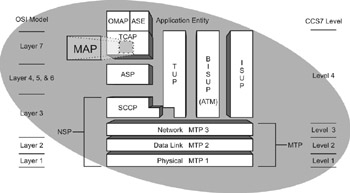
 The Mobile Application Part (MAP) specifies the application protocols between Mobile Switching Centers (MSCs) and related SS7 network equipment assemblies and databases that are used in wireless networks. Figure 10.1 shows how MAP related services information is contained within the TCAP portion of the SS7 Protocol Stack.
Wireless networks inter-connect wireless telephones with nearby radio towers that route calls through switching systems to other wireless telephones or to other telephones or data networks. Wireless networks consist of cell site radio towers (called Base Stations ), communication links, switching centers and network databases. Wireless networks usually interconnect to public telephone and data networks such as the Internet.
The main switching system in the mobile telephone service, wireless network is the mobile switching center (MSC). The MSC coordinates the overall allocation and routing of calls throughout the wireless system. Inter-system connections can link different wireless network systems together to allow wireless telephones to move from cell site to cell site and system to system. The mobile system defines inter-system connections in detail to allow universal and uniform service availability for mobile wireless devices.
Figure 10.2 illustrates the fundamental parts and interconnections in a mobile communication network. The mobile station (MS) is a wireless telephone. The network radio parts, found near the base of an antennae structure, are composed of radio base station transceiver sub-systems (called BTS) and controlling these BTSs, are base station controllers (BSCs). The base station controllers accept converted...