SS7 Basics, Second Edition
This guidebook provides an overview of SS7 technologies, how they are structured, and why they are important.
 TABLE OF CONTENTS
 The Broadband ISDN User Part (B-ISUP) was developed to allow SS7 to support the control of voice and data communication on asynchronous transfer mode (ATM) systems. The ATM system is a connection-oriented packet switching system that allows for combined voice, data, and video services through the use of high-speed switches, prioritizing and transferring many small packets efficiently.
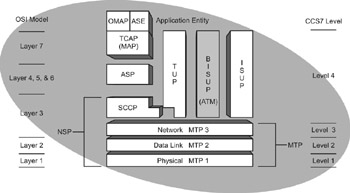
The key differences between ISUP and B-ISUP include new types of channel identifiers, several types of adaptation protocols, capability of assigning bandwidth allocations to switching systems, broadband and narrowband capabilities and how they interface with each other, and system recovery procedures for congestion control. Figure 12.1 shows the Broadband ISDN User Part (B-ISUP) relative to the other connection-oriented protocols in the SS7 Protocol stack.
Asynchronous transfer mode (ATM) is a packet data transmission and switching system that transfers information by dividing all types of data into small fixed length packets of data (53 byte cells). The ATM system uses high-speed transmission (usually 155 Mbps or above) and is a connection-based system. When an ATM circuit is established, a path through multiple switches is setup and remains in place until the connection is completed. ATM service was developed to allow one communication medium (high-speed packet data) to provide for voice, data, and video service.
As of the 1990 s, ATM has become a standard for high-speed digital backbone networks. ATM are widely used by large telecommunications service providers to interconnect their network systems. ATM...