SS7 Basics, Second Edition
This guidebook provides an overview of SS7 technologies, how they are structured, and why they are important.
 TABLE OF CONTENTS
 The basic function of the Integrated Services Digital Network User Part (ISDN-UP) in the SS7 system is to control setup, connection, and release of circuit switched network connections between subscriber line exchange terminations. This includes basic voice and data services and supplementary services.
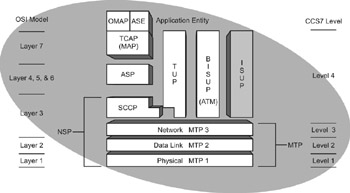
Previous to developing the ISDN-UP, the standards groups developed the Telephone User Part (TUP) and the Data User Part (DUP). The ISDN-UP provides all the functions of both the TUP and the DUP, and is expected over time to replace their implementations. Figure 6.1 shows how the ISDN-UP provides some of the functionality of OSI Layers 3 through 7.
Services controlled by the SS7 system include voice and data transmission. Services can be divided into basic bearer services (e.g. voice transport) and supplementary services (e.g., call redirecting).
The basic bearer service for SS7 uses the ISDN-UP to control of 56 Kb/s or 64 Kb/s circuit-switched voice or data connections. This service, termed the basic bearer service is divided into three phases. In this way, it is similar to the SCCP connection-oriented service. These phases include: call setup, connection, and call release.
Call setup involves the initiation of a call, determination of the destination of the receiving device (e.g., destination switching exchange), alerting of the destination device that a call is to be received, and connection of a voice path through the network. Figure 6.2 shows example steps for the call setup process.