SS7 Basics, Second Edition
This guidebook provides an overview of SS7 technologies, how they are structured, and why they are important.
 TABLE OF CONTENTS
 There are different version of SS7 that are used throughout the world. Some of the variations of SS7 systems include different point code addressing, circuit identification code (CIC) formats, transcoding control requirements, and international gateway support.
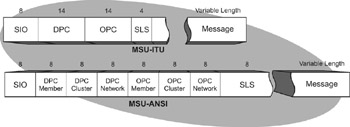
SS7 addressing involves the use of destination point code (DPC) and origination point code (OPC). The use of point codes identifies specific equipments and possibly functional assemblies within these equipments. The number of bits assigned to point codes by ANSI is 24 and by ITU is 14. The assignment of these point codes to specific operators and system also varies. ANSI divides their point codes into 8 bit groups of member, cluster, and network groups. This allows each operator that uses ANSI to have at least 65,536 unique point code addresses.
Figure 15.1 shows the basic differences between the SS7 MSUs packet structures as defined by ANSI and the ITU. This diagram shows that the ITU version uses a destination point code (DPC) and origination point code (OPC) that are 14 bits long. The ANSI MSU version uses a DPC and OPC codes that are 24 bits. The ANSI DPC and OPC codes are also divided into hierarchical structure that has member, cluster, and network groups of 8 bits each.
The circuit identification code (CIC) is an information code that identifies a circuit between a pair of SS7 exchanges for which signaling is being performed (14 bits in the ANSI version and 12...