Understanding Synthetic Aperture Radar Images
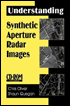
By helping you to quickly assess which components of an SAR image should be measured, this book enables you to devote more time and energy to the real task of image interpretation and analysis.
 TABLE OF CONTENTS
 In the last few years, high quality images of the Earth produced by synthetic aperture radar (SAR) systems carried on a variety of airborne and spaceborne platforms have become increasingly available. Two major leaps forward were provided by the launch of the ERS-1 satellite by the European Space Agency in 1991 and the advent of very flexible airborne systems carrying multifrequency polarimetric SARs, of which the NASA/JPL AirSAR provides perhaps the single most influential example. These systems ushered in a new era of civilian radar remote sensing because of their emphasis on SAR as a measurement device, with great attention being paid to data quality and calibration. This emphasis continues to play a major part in the development, deployment, and application of current systems.
ERS-1 was the first in a series of orbital SARs planned to have long lifetimes and semioperational capabilities. The JERS-1, ERS-2, and Radarsat satellite systems are currently in orbit, with ENVISAT planned for launch in 1999. By providing a long time series of accurate measurements of the backscattering coefficient, these satellites allow dynamic processes to be observed over most of the Earth's surface, with impacts in many areas, such as vegetation mapping and monitoring, hydrology, sea-ice mapping, and geology. The unique capability of SAR to exploit signal phase in interferometry has given rise to completely new tools for glaciology and the study of tectonic activity.
Because of the constraints imposed by deploying a radar in space, these systems are simple, in the sense of using...