Understanding Synthetic Aperture Radar Images
By helping you to quickly assess which components of an SAR image should be measured, this book enables you to devote more time and energy to the real task of image interpretation and analysis.
 TABLE OF CONTENTS
 The nature of information in SAR images was discussed in Chapter 4. Deriving information from these images is a process in which image data are interpreted in light of prior knowledge that is encapsulated in models for both the data and scene properties. In the following chapters we will demonstrate how different data models can be combined with world models in providing optimized information extraction for image interpretation.
To focus the discussion, consider the SAR image in Figure 5.1. The resolution is 1.5m by 1.5m, so details such as a road, clumps of trees, and hedges with associated shadow are clearly visible. In addition, extended areas of clutter, such as the field and woodland areas delineated by white borders are made up of scattering from unresolved objects. Let us start by considering the properties of these two clutter regions.
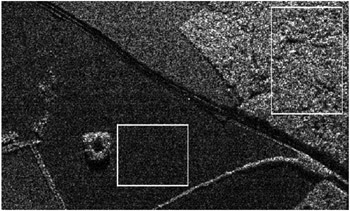
We have shown in Chapter 4 that speckle arises if the scattering elements within a pixel are randomly distributed. The intensity fluctuations within the field region in Figure 5.1 appear consistent with such a model. We shall discuss the implications of speckle in Section 5.4 in the context of a product model that we exploit in Chapters 6 and 7 in deriving information about the underlying cross section in a SAR image, ?. This is estimated from the observed...