Understanding Synthetic Aperture Radar Images
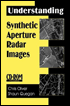
By helping you to quickly assess which components of an SAR image should be measured, this book enables you to devote more time and energy to the real task of image interpretation and analysis.
 TABLE OF CONTENTS
 With single-channel data, only one of the copolarized quantities S hh or S vv is normally available and, as we have seen in Chapter 4, for distributed targets the phase carries no useful information. Hence, taken in isolation, each channel provides only one useful number per pixel, viz. an estimate of ? in that channel. When multiple channels are available, the true basis of speckle in electromagnetic scattering becomes manifest. Phase (or rather, phase difference) now provides information both as a useful statistical parameter and in the physical sense of corresponding to dielectric and geometric properties of the scattering medium. Hence, for polarimetric data the potential information per pixel is five real numbers, given by the intensities and the phase differences of the three channels. However, when dealing with distributed scatterers, we showed that the actual information per pixel is much lower because individual pixels are simply random samples from distributions characterized by a small number of parameters. In fact, large areas of single-channel SAR images are completely characterized by the mean ? (if untextured) or the mean ? and an order parameter (and possibly spatial correlation properties) if textured.
If there exist similar simple models for the distributions observed in polarimetric data they would clearly be of great value because they would do the following:
Define the information content of the data.
Isolate the set of measurements needed to characterize the scattering properties of distributed targets and, hence, that need...