Understanding Synthetic Aperture Radar Images
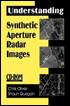
By helping you to quickly assess which components of an SAR image should be measured, this book enables you to devote more time and energy to the real task of image interpretation and analysis.
 TABLE OF CONTENTS
 Perhaps the most remarkable feature of our understanding of SAR images is that very simple, approximate models can provide good representations of the properties of the images. Almost all of the developments described in this book flow from four such models.
The complex SAR image is formed by linear filtering of the complex reflectivity of the scene; this linear filter (the SAR PSF) is divisible into the product of a range and azimuth PSF.
The complex reflectivity of the scene can be described by a set of discrete scatterers, envisaged as point scatterers, facets, or volume scattering elements. For distributed targets, these scatterers are randomly positioned in the resolution cell.
Within distributed scatterers, the properties of the underlying scatterers change slowly in comparison with the resolution length.
Image structure arises from discontinuities in one or more measurable image properties.
From the first of these, we can immediately infer the behavior of single point targets, or small clusters of targets, with correct representations of the interference between them. The sampling properties of the data are also immediate. From the second, in combination with the first, the properties of speckle arise. When there are very many scatterers in every resolution cell, the complex reflectivity can be represented as a white Gaussian process, so the complex image is a correlated Gaussian process where correlation is determined by the PSF. All the elementary properties of distributed and point targets follow and allow us to quantify the role of targets, distributed scatterers, and...