Understanding Synthetic Aperture Radar Images
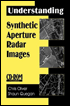
By helping you to quickly assess which components of an SAR image should be measured, this book enables you to devote more time and energy to the real task of image interpretation and analysis.
 TABLE OF CONTENTS
 When trying to extract information from SAR images, we need to distinguish two types of image property. The more important is where properties of the scene (e.g., its dielectric constant, its geometry, its motion, etc.) produce effects in the image; measurements or examination of the image then can provide information about the scene. The second is generated purely by the system and the signal processing. This is important for anyone interested in characterizing system performance, but within the context of this book, its primary significance is in how it affects our ability to recognize image properties generated by the external world. The system can modify, distort, or produce uncertainties in these properties. An important distinction is between intrinsic properties of the imaging system, which cannot be overcome, and artifacts produced by errors or inadequacies in the system behavior and the signal processing. In this chapter, our main concern will be to establish an ideal model for SAR imaging and to show that many of the intrinsic properties are determined by a small number of choices in the system design. Effects due to system failings and how to overcome them are dealt with in Chapter 3. The remainder of the book is mainly concerned with data free from such problems. The treatment of SAR processing underlying this chapter is deliberately simplified so that the key issues in how image properties are dependent on system decisions are not obscured. Readers who desire a more sophisticated approach will find several excellent...