Understanding Synthetic Aperture Radar Images

By helping you to quickly assess which components of an SAR image should be measured, this book enables you to devote more time and energy to the real task of image interpretation and analysis.
 TABLE OF CONTENTS
 Here we deal only with the most common form of polarimetric SAR, in which a linearly polarized signal is transmitted and two orthogonal polarizations of the backscattered signal are measured. When a horizontally polarized wave is transmitted, the signals received in the horizontal (H) and vertical (V) channels undergo separate SAR processing to produce measurements S hh and S vh of the local copolarized and crosspolarized complex scattering amplitudes. By interleaving H and V polarized transmitted pulses, the corresponding terms S vv and S hv can also be measured to give the full polarimetric response of a scatterer. These four measurements allow the response to an arbitrary transmitted polarization to be calculated (for a fixed frequency, incidence angle, resolution, and time), as follows. Any polarization state of the transmitted wave can be uniquely described by an electric field vector of the form
| (11.1) | 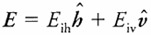 |
where the subscript i denotes incident and  and
and  are unit vectors defined by
 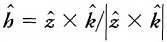 and
and  . Here
  is a unit normal to the Earth's surface and
  is a unit vector parallel to the wave vector k. The backscattered wave observed at a distance R in the far field of the scatterer is then given by
| (11.2) | 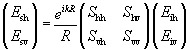 |
where the subscript s denotes scattered. Note that in this expression the coordinate system is throughout defined relative to the direction of the transmitted wave (the backscatter alignment convention); the transformations needed if the scattered wave...