Understanding Synthetic Aperture Radar Images

By helping you to quickly assess which components of an SAR image should be measured, this book enables you to devote more time and energy to the real task of image interpretation and analysis.
 TABLE OF CONTENTS
 Section 11.3 indicated the importance of the multidimensional Gaussian distribution in describing polarimetric data, and we now develop its implications. The fundamental fact about a homogeneous Gaussian-distributed target is that all the information is carried by the covariance matrix C, which can be expressed in the form
| (11.16) | 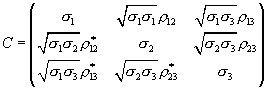 |
where
| (11.17) |  |
| (11.18) |  |
is the backscattering coefficient in channel k and
| (11.19) |  |
is the complex correlation coefficient of channels k and l. If we have accurate estimates of these nine real parameters (three real backscattering coefficients and three amplitudes and phases of the correlation coefficients) we know everything there is to know about the measurable properties of the target. This at last allows us to display images that describe the information content of the data.
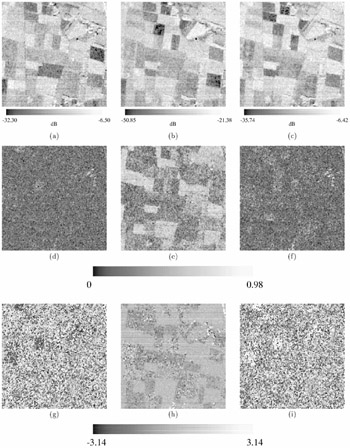
Figures 11.1 to 11.3 show estimates of these parameters from the NASA/JPL AirSAR system [18] at C-, L-, and P-bands for an agricultural region in East Anglia, UK, acquired during the MacEurope campaign in 1992 [19]. The detailed properties of these images will be discussed later, but certain features are immediately obvious.
The dynamic range and image contrast increase with wavelength.
The copolarized correlation coefficient appears to carry more information than the crosspolarized, both in its amplitude and phase, especially at C-band.
Correlation phase is better defined when the correlation amplitude is larger and appears noiselike when the correlation amplitude is low.