Understanding Synthetic Aperture Radar Images
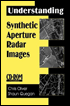
By helping you to quickly assess which components of an SAR image should be measured, this book enables you to devote more time and energy to the real task of image interpretation and analysis.
 TABLE OF CONTENTS
 In the previous chapter the emphasis was directed toward reconstructing the RCS at each pixel. This was based on exploiting phenomenological models for speckle and RCS combined with a series of world models that introduced constraints into the reconstruction. In this chapter the approach is again based on the product and speckle models but relies on other forms of constraint to derive information. In Section 7.2 we associate each pixel with a particular class, taken from a restricted set representing RCS values. We demonstrate the need to average over many pixels before such classification can be effective, which is only sensible if the boundaries of the averaging window lie within a region of constant RCS in the image. This leads to the cartoon model, described in Section 7.3, and its application in segmentation. Finally, while the principles of these information-extraction techniques may be elegant, most users are primarily concerned with their effectiveness at fulfilling specific image-interpretation functions. Thus, we will consider quantitative image-quality measures for the different algorithms in Section 7.4. In Section 7.5 a discussion of the principles underlying the exploitation of both reconstruction and segmentation is presented.
Rather than estimating the RCS, as described in the previous chapter, we might attempt to classify each pixel in terms of its RCS. Suppose that a restricted set of possible RCS values is selected and each pixel assigned to the nearest class. Speckle causes uncertainty in this assignment. An optimized classifier for the known...