Understanding Synthetic Aperture Radar Images
By helping you to quickly assess which components of an SAR image should be measured, this book enables you to devote more time and energy to the real task of image interpretation and analysis.
 TABLE OF CONTENTS
 The concept of an object being a target reflects military terms of reference in which the scene is regarded as consisting of background clutter and a small number of significant objects (i.e., targets), which are generally man-made, such as buildings, bridges, or vehicles. These cannot be treated as homogeneous, like natural clutter, but are characterized by local structure rather than texture, which is position dependent. Indeed, the scattered radiation requires a deterministic coherent treatment in which the relative phase of each scatterer is retained.
In Figure 10.1(a) we show a simulated image of a tanklike vehicle at a resolution of 3m with no background. Though there is little evidence of structure at this resolution, the image is clearly asymmetric. Forming an equivalent image at a resolution of 0.75m, as shown in Figure 10.1(b), illustrates that the target return is dominated by four major scatterers, clearly resolved under these conditions. Since targets are dominated by a few well-separated scatterers, essential information is contained in the phase and amplitude relationships between them.
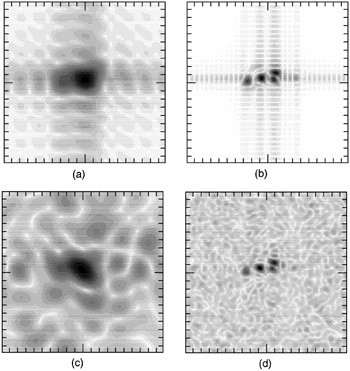
In addition to targets, each scene comprises a majority of pixels containing clutter that provides the background against which targets must be detected. The result of adding a uniform speckle background...