VLIW Microprocessor Hardware Design: For ASIC and FPGA

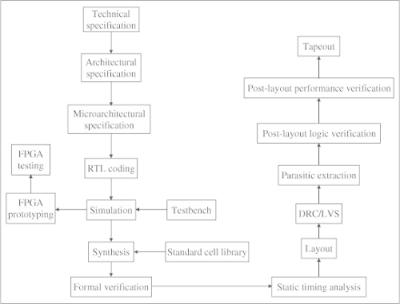
To design a VLIW microprocessor, the first step is to determine the design methodology. The methodology will show each step that needs to be taken from the beginning of the microprocessor design to verification and final testing. Figure 2.1 shows the design methodology that is used for the design of the VLIW microprocessor.
This is the beginning of the design methodology flow. In this step, the technical features and capability of the VLIW and superscalar pipeline microprocessor are defined. The specifications will influence the architecture and microarchitecture of the microprocessor. From the specifications, all design considerations are made with respect to meeting the specified technical requirements. A list of the technical specifications for the design and implementation of the microprocessor follows:
Must be able to operate at 3.0V conditions
In order for the design to operate in 3.0V conditions, the fab process technology considered for doing the design must be able to support 3.0V operation.
Normally, the chosen fab for fabricating the design will have different technology catered to different operating voltages and design requirements. The technologies provided by the fab may cover 5V operations, 3V operations, 1.8V operations or lower, mixed signal design, logic design, or RF design.
Performance must meet a minimum of 200 MIPS (200 million instructions per second)
This is an important requirement that will have great impact on the architectural specification. By having a minimum requirement of 200 MIPS, the architecture of the VLIW microprocessor...