Circuit Design: Know It All

In many cases, Ohm's Law alone is insufficient to determine the magnitude of the voltages and currents present in a circuit. This section introduces several techniques that simplify the task of solving complex circuits. It also introduces the concept of exponential growth and decay of voltage and current in circuits containing capacitance and resistance and inductance and resistance. It concludes by showing how humble C-R circuits can be used for shaping the waveforms found in electronic circuits. We start by introducing two of the most useful laws of electronics.
Kirchhoff's Laws relate to the algebraic sum of currents at a junction (or node) or voltages in a network (or mesh). The term "algebraic" simply indicates that the polarity of each current or voltage drop must be taken into account by giving it an appropriate sign, either positive (+) or negative ( ?).
Kirchhoff's Current Law states that the algebraic sum of the currents present at a junction (node) in a circuit is zero (see Figure 1.66).
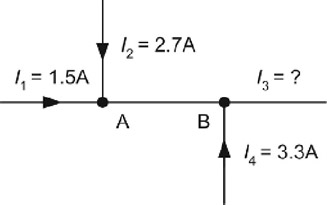
In Figure 1.67, use Kirchhoff's Current Law to determine:
the value of current flowing between A and B, and
the value of I 3.
Solution
I 1 and I 2 both flow toward Node A so, applying our polarity convention, they must both be positive. Now, assuming that a current I 5 flows between A and B...