Circuit Design: Know It All

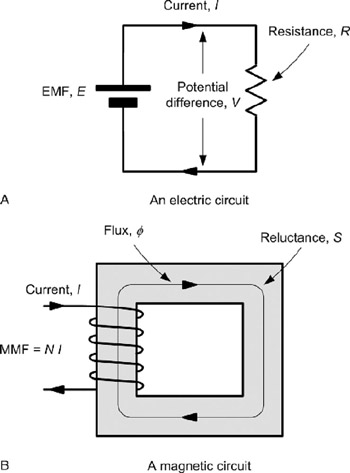
Materials such as iron and steel possess considerably enhanced magnetic properties. They are employed in applications where it is necessary to increase the flux density produced by an electric current. In effect, magnetic materials allow us to channel the electric flux into a "magnetic circuit," as shown in Figure 1.14.
In the circuit of Figure 1.14(B), the reluctance of the magnetic core is analogous to the resistance present in the electric circuit shown in Figure 1.14(A). We can make the following comparisons between the two types of circuit (see Table 1.7).
| Electric circuit Figure 1.14(A) | Magnetic circuit Figure 1.14(A) |
|---|---|
| Electromotive force, e.m.f. = V | Magnetomotive force, m.m.f. = N I |
| Resistance = R | Reluctance = S |
| Current = I | Flux = ? |
| e.m.f. = current resistance | m.m.f. = flux reluctance |
| V = I R | N I = S ? |
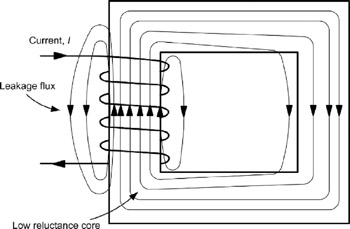
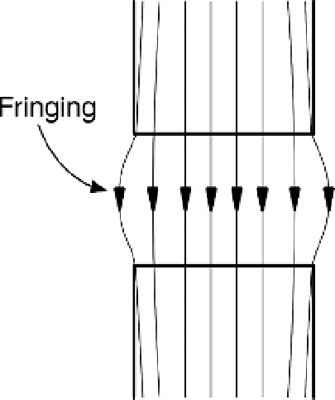
In practice, not all of the magnetic flux produced in a magnetic circuit will be concentrated within the core and some "leakage flux" will appear in the surrounding free space (as shown in Figure 1.15). Similarly, if a gap appears within the magnetic circuit, the flux will tend to spread out as shown in Figure 1.16. This effect is known as fringing.