Circuit Design: Know It All

Stuart Ball
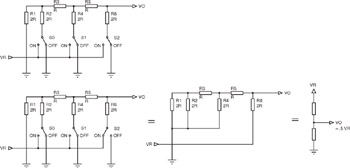
Although this chapter is primarily about analog-to-digital converters (ADCs), an understanding of digital-to-analog converters (DACs) is important to understanding how ADCs work. Figure 20.1 shows a simple resistor ladder with three switches. The resistors are arranged in an R/2R configuration. The actual values of the resistors are unimportant; R could be 10K or 100K or almost any other value. Each switch, S0 S2, can switch one end of one 2R resistor between ground and the reference input voltage, VR. The Figure shows what happens when switch S2 is on (connected to VR) and S1 and S2 are OFF (connected to ground). By calculating the resulting series/parallel resistor network, the final output voltage (VO) turns out to be 0.5 VR. If we similarly calculate VO for all the other switch combinations, we get the results shown in Table 20.1:
| S2 | S1 | S0 | Vo |
|---|---|---|---|
| OFF | OFF | OFF | 0 |
| OFF | OFF | ON | 0.125 VR (1/8 VR) |
| OFF | ON | OFF | 0.25 VR (2/8 VR) |
| OFF | ON | ON | 0.375 VR (3/8 VR) |
| ON | OFF | OFF | 0.5 VR (4/8 VR) |
| ON | OFF | ON | 0.625 VR (5/8 VR) |
| ON | ON | OFF | 0.75 VR (6/8 VR) |
| ON | ON | ON | 0.875 VR (7/8 VR) |
If the three switches are treated as a 3-bit digital word, then we can rewrite the table as shown in Table 20.2 (using ON = 1; OFF...