Circuit Design: Know It All

Peter Wilson
This application example chapter concentrates on the key topic of integrating processors onto field-programmable gate array (FPGA) designs. This ranges from simple 8-bit microprocessors up to large IP processor cores that require an element of hardware-software co-design involved. This chapter will take the reader through the basics of implementing a behavioral-based microprocessor for evaluation of algorithms, through to the practicalities of structurally correct models that can be synthesized and implemented on an FPGA.
One of the major challenges facing hardware designers in the 21st century is the problem of hardware-software co-design. This has moved on from a basic partitioning mechanism based on standard hardware architectures to the current situation where the algorithm itself can be optimized at a compilation level for performance or power by implementing appropriately at different levels with hardware or software as required.
This aspect suits FPGAs perfectly, as they can handle fixed hardware architecture that runs software compiled onto memory, they can implement optimal hardware running at much faster rates than a software equivalent could, and there is now the option of configurable hardware that can adapt to the changing requirements of a modified environment.
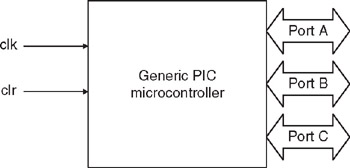
A useful example of an embedded processor is to consider a generic microcontroller in the context of an FPGA platform. Take a simple example of a generic 8-bit microcontroller shown in Figure 31.1.
As can be seen from Figure 31.1, the microcontroller is a...