Circuit Design: Know It All

Chapter 10: Combinational Logic Design

Ian Grout

10.1 Introduction

Using the previous ideas, combinational logic circuits can be combined using either the first canonical form (sum of products) or the second canonical form (product of sums). However, in this text only the first canonical form will be considered, taking into account logic level 0 or 1 and propagation (time) delays in the cells.

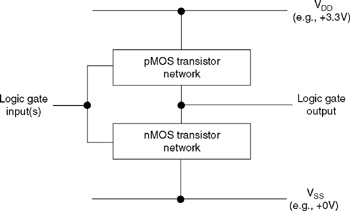
Within a logic gate is an analog circuit consisting of transistors either bipolar, using NPN and PNP bipolar junction transistors, or CMOS (complementary metal-oxide semiconductor), using N-channel MOS and P-channel MOS transistors. Logic gates in CMOS are of three different circuit architectures at the transistor level [Ref. 10.1]: static CMOS, dynamic CMOS, and pass transistor logic CMOS. Today, static CMOS logic is by far the dominant type used. It is built on a network of pMOS and nMOS transistors connected between the power supplies, as shown in Figure 10.1.


Figure 10.1: Static CMOS logic gate architecture

The input signals are connected to the gates of the transistors, and the output is taken from the common connection between the transistor networks. The transistors will act as switches, with the switch connections between the drain and source of the transistor. Switch control is via a gate voltage:

  • An nMOS transistor will be switched ON when high voltage (logic 1) is applied to the transistor gate. Low voltage (logic 0) will turn the switch OFF.

  • A pMOS transistor will be switched ON when low voltage (logic 0) is applied to the transistor gate. High...

UNLIMITED FREE
ACCESS
TO THE WORLD'S BEST IDEAS

SUBMIT
Already a GlobalSpec user? Log in.

This is embarrasing...

An error occurred while processing the form. Please try again in a few minutes.

Customize Your GlobalSpec Experience

Category: Logic Decoders and Demultiplexers
Finish!
Privacy Policy

This is embarrasing...

An error occurred while processing the form. Please try again in a few minutes.