Circuit Design: Know It All

Chapter 12: Memory

Ian Grout

12.1 Introduction

Memory is used to store, provide access to, and allow modification of data and program code for use within a processor-based electronic circuit or system. The two basic types of memory are ROM (read-only memory, and RAM (random access memory). Memory can be considered for use for one of the following three data or program storage purposes:

  1. Permanent storage for values that are normally only read within the application and can be changed (if at all) only by removing the memory from the application and reprogramming or replacing it.

  2. Semi-permanent storage for values that can be read only within the application (as with permanent storage). However, stored values can be modified by reprogramming while the memory remains in the circuit.

  3. Temporary storage for values needed only for temporary use and requiring fast access or modification (such as data and program code within a computer system that can be removed when no longer needed).

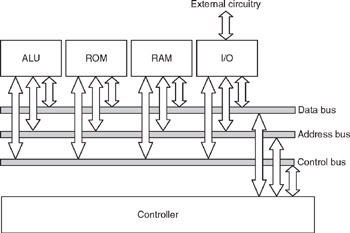
These memories are typically used within a computer architecture of the form shown in Figure 12.1. Here, the ROM and RAM are connected to the other computer functional blocks:

  • ALU, arithmetic and logic unit;

  • I/O, input/output to external circuitry; and

  • controller to provide the necessary timing for the circuitry.


Figure 12.1: Basic computer architecture

Each of the functional blocks is connected to a common set of data, address, and control lines required to access and manipulate the digital data at specific points in time. Also needed is...

UNLIMITED FREE
ACCESS
TO THE WORLD'S BEST IDEAS

SUBMIT
Already a GlobalSpec user? Log in.

This is embarrasing...

An error occurred while processing the form. Please try again in a few minutes.

Customize Your GlobalSpec Experience

Category: Memory Chips
Finish!
Privacy Policy

This is embarrasing...

An error occurred while processing the form. Please try again in a few minutes.