Radio-frequency equipment is used for a vast range of purposes, including heat treating special steels, medical diathermy treatment for cancer, heat sealing plastic bags, and experiments in atomic physics. Nevertheless, as the name implies, the original use was in connection with the transmission of information by radio waves. The earliest form of this was wireless telegraphy (WT) using Morse code. This was followed by wireless telephony and, much later, broadcasting radio and television. So, before diving into RF circuits in detail, a word might be in order about the different forms of modulation employed to impress the information to be transmitted onto the radio wave.
23.1 Modulation of Radio Waves
Figure 23.1A shows how information is transmitted by means of an interrupted continuous wave, often called simply continuous wave (CW). This type of modulation is frequently employed in the high-frequency (HF) band; that is, from 1.6 to 30 MHz. In a simple transmitter either the oscillator would be "keyed" on and off with a Morse key, or alternatively the drive signal or the power supply to the output stage would be likewise keyed. In the simplest possible transmitter there would be no separate output stage, only a keyed oscillator. Using CW, amateur radio enthusiasts can contact others in any country in the world using only a few watts, but only as and when propagation conditions are favorable.
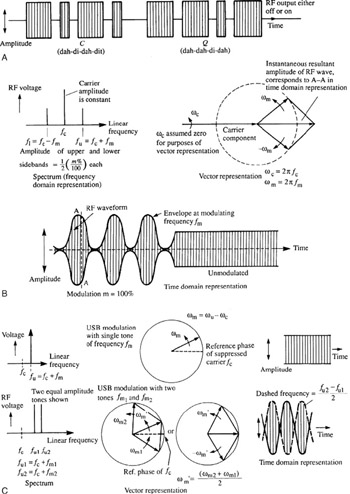 Figure 23.1: Types of modulation of radio waves. (A) CW modulation. The letters CQ in Morse (seek you?) are used by...
Copyright Elsevier Inc. 2008 under license agreement with Books24x7


 TABLE OF CONTENTS