Circuit Design: Know It All

Stuart Ball
This chapter contains some miscellaneous topics that pull together multiple concepts from preceding chapters.
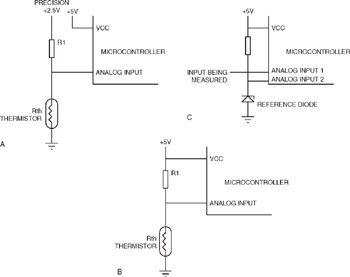
In many cases, you can minimize the effects that supply voltage can have by referencing your analog inputs to the supply voltage. Figure 34.1A shows a thermistor connected to an analog input and using a pull-up to a precision reference voltage. At first glance, it might appear that this is a very accurate design because the precision reference gives a repeatable voltage versus temperature at the analog input. The problem with this design is that the microcontroller is measuring the temperature using the supply voltage as a reference, so the overall accuracy is only as good as the microcontroller supply voltage.
Figure 34.1B shows the same circuit, but with the thermistor referenced to the microcontroller supply. This provides a more repeatable result. If the thermistor is 10K and R1 is 10K, for example, the analog input to the microcontroller will always sense half the supply voltage regardless of what the supply voltage actually is. This method will work only if the analog input can be made to follow the supply voltage. This essentially means that the output being measured by the microcontroller is referenced to the supply. Note that just powering the sensor or sensor circuit from the microcontroller supply may not be sufficient. If the sensor circuit has its own internal reference that controls the output value, it will produce the same output...