Circuit Design: Know It All

Peter Wilson
An important part of systems that interface to the "real world" is the ability to process sampled data in the digital domain. This is often called sampled-data systems (SDS) or operating in the Z-domain. Most engineers are familiar with the operation of filters in the Laplace or S-domain where a continuous function defines the characteristics of the filter and this is the digital domain equivalent to that.
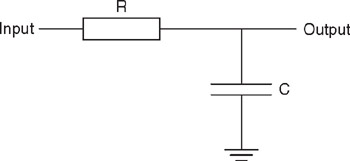
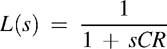
For example, consider a simple RC circuit in the analog domain as shown in Figure 32.1. This is a low-pass filter function and can be represented using the Laplace notation shown in Figure 32.1.
This has the equivalent S-domain (or Laplace) function as follows:
This function is a low-pass filter because the Laplace operator s is equivalent to, j ? where w = 2 ?f (with f being the frequency). If f is zero (the DC condition), then the gain will be 1, but if the value of sCR is equal to 1, then the gain will be 0.5. This in dB is ?3 dB and is the classical low-pass filter cut-off frequency.
In the digital domain, the s operation is replaced by Z. Z ?1 is practically equivalent to a delay operator, and similar functions to the Laplace filter equations can be constructed for the digital, or Z-domain equivalent.
There are a number of design techniques, many beyond the scope of this book (if the...