Circuit Design: Know It All

Ron Mancini
Darren Ashby
Richard Palmer
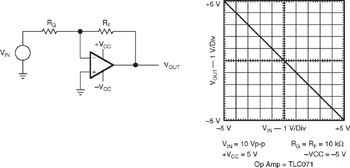
Portable and single-supply electronic equipment is becoming more popular each day. The demand for single-supply op-amp circuits increases with the demand for portable electronic equipment because most portable systems have one battery. Split- or dual-supply op-amp circuit design is straightforward because op-amp inputs and outputs are referenced to the normally grounded center tap of the supplies. In the majority of split-supply applications, signal sources driving the op-amp inputs are referenced to ground, thus with one input of the op-amp referenced to ground, as shown in Figure 26.1, there is no need to consider input common-mode voltage problems.
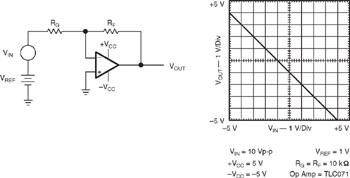
When the signal source is not referenced to ground (see Figure 26.2 and Equation 26.19), the voltage difference between ground and the reference voltage shows up amplified in the output voltage. Sometimes this situation is OK, but other times the difference voltage must be stripped out of the output voltage.
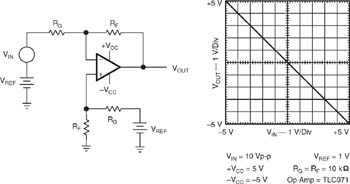
An input bias voltage is used to eliminate the difference voltage when it must not appear in the output voltage (see Figure 26.3 and Equation 26.3). The voltage, V REF, is in both input circuits, hence it is named a common-mode voltage. Voltage-feedback op-amps, like those used in this document, reject common-mode voltages because their input circuit is constructed with a differential amplifier (chosen because it has natural common-mode voltage rejection capabilities).