Circuit Design: Know It All

Ian Grout
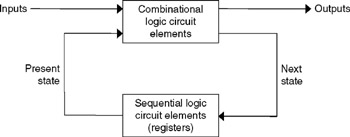
Sequential logic circuits are based on combinational logic circuit elements (AND, OR, etc.) working alongside sequential circuit elements (latches and flip-flops). A generic sequential logic circuit is shown in Figure 11.1. Here, the circuit inputs are applied to and the circuit outputs are derived from a combinational logic block. The sequential logic circuit elements store an output from the combinational logic that is fed back to the combinational logic input to constitute the present state of the circuit. The output from the combinational logic that forms the inputs to the sequential logic circuit elements constitutes the next state of the circuit. These sequential logic circuit elements are grouped together to form registers. The circuit changes state from the present state to the next state on a clock control input (as happens in a synchronous sequential logic circuit). Commonly, the D-latch and D-type flip-flops are used (rather than other forms of latch and flip-flop such as the S-R, toggle, and J-K flip-flops), and they will be discussed in this text. The output from the circuit is taken from the output of the combinational logic circuit block.
In general, sequential logic circuits may be asynchronous or synchronous:
Asynchronous sequential logic. This form of sequential logic does not use a clock input signal to control the timing of the circuit. It allows very fast operation of the sequential logic, but its operation is prone to timing problems where...