
Boiler Control Temperature Controllers
Last Updated: April 1, 2025
Description
Boiler control temperature controllers are devices designed to monitor and maintain variables such as steam temperature and pressure in boilers. They control the boiler’s burner or air mixture to ensure optimal performance. These controllers can vary in functionality, user interface, and form factor, offering features like rate indication, totalizing, data logging, and chart recording. They may include digital front panels or analog components such as knobs and switches, and can be computer-programmable, web-enabled, and network-ready .
Working Principle
Boiler control temperature controllers operate by using various control techniques to maintain the desired temperature and pressure within a boiler. They can utilize limit control, which establishes set points that trigger actions when reached, or more advanced methods like PID (Proportional, Integral, Derivative) control, which requires real-time system feedback to adjust the control signals accurately. These controllers can also employ feedforward control, which provides direct-control compensation from the reference signal, and fuzzy logic, which allows for imprecise values rather than binary statuses .
Applications
Boiler control temperature controllers are used in various industrial settings where precise temperature and pressure control is crucial. For example, they are employed in power plants to manage steam generation, in chemical processing industries to maintain reaction conditions, and in food processing facilities to ensure consistent cooking or pasteurization temperatures .
Advantages over other Temperature Controllers
Boiler control temperature controllers offer several advantages over general-purpose temperature controllers. They are specifically designed to handle the unique requirements of boiler systems, such as managing steam pressure and burner control. This specialization allows them to provide more accurate and reliable control in boiler applications compared to general-purpose controllers, which may not be optimized for such specific tasks .
Limitations
One limitation of boiler control temperature controllers is their complexity, which can make them more challenging to set up and maintain compared to simpler temperature controllers. Additionally, they may require more frequent calibration and maintenance to ensure accuracy and reliability, especially in demanding industrial environments .
Considerations
When selecting a boiler control temperature controller, several factors should be considered. Initial costs can vary depending on the complexity and features of the controller. Operating expenses may include energy consumption and maintenance costs. Durability is crucial, as these controllers often operate in harsh industrial environments. Accuracy is essential for maintaining optimal boiler performance, and replacement and maintenance costs should be factored into the overall cost of ownership. It's important to choose a controller that balances these considerations to meet the specific needs of the application .
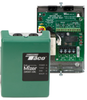
from Taco Comfort Solutions
The FuelMizer ™ (SR501-OR) is a microprocessor-based control designed to regulate the supply water temperature of a single boiler, based on the outdoor temperature. The FuelMizer is a boiler reset control and switching relay in one unit; it is ideal for retrofit application, but may also be... [See More]
- Controller Type: Boiler
- Control Signal: Switched Output