
FLASH Memory Chips Information
Last revised: December 9, 2024
Reviewed by: Scott Orlosky, consulting engineer
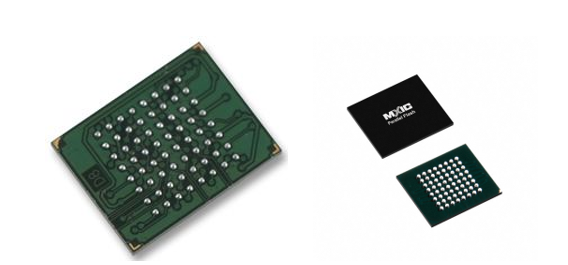
Image Credit: Newark / element14 | Digi-Key Corporation
Flash memory chips are electrically erasable, programmable, read-only memory (EEPROM) chips that can be erased and reprogrammed in blocks instead of one byte at a time. Because they are non-volatile, Flash memory chips do not need a constant power supply to retain their data. Flash memory chips offer extremely fast access times, low power consumption, and relative immunity to severe shock or vibration. They have a lifespan, also known as write endurance of approximately 100,000 write cycles — a fact that makes Flash unsuitable for use as computer main memory. Typically, Flash memory chips are used in portable or compact devices such as digital cameras, cell phones, and scanners. Flash memory chips are also used as solid-state disks in laptops and as memory cards for video game consoles.
Types of Flash Memory
Flash memory chips vary in terms of density, boot block size, number of words, bits per word, gate technology, and special features. Density is the capacity of the chip in bits. Boot block size is a secured block used to store boot codes. The number of words equals the number of rows, each of which stores a memory word and connects to a word line for addressing purposes. The bits per word are the number of columns, each of which connects to a sense / write circuit. Some Flash memory chips support NAND or serial access gate technology. Other devices support NOR or random access gate technology. In terms of special features, Flash memory chips can be read either in bursts of bits or page-by-page. Flash memory chips that provide read-while-write (RWW) operation can be read and written to at the same time.
How to Select
Selecting Flash memory chips requires an analysis of performance specifications such as access time, data retention, endurance, supply voltage, and operating temperature. Measured in nanoseconds (ns), access time indicates the speed of memory and represents a cycle that begins when the CPU sends a request to memory and ends when the CPU receives the data requested. Data retention is the number of years that chips can retain data without reloading. Endurance is the maximum number of read/write cycles that chips can support. Supply voltages range from - 5 V to 5 V and include intermediate voltages such as -4.5 V, -3.3 V, -3 V, 1.2 V, 1.5 V, 1.8 V, 2.5 V, 3 V, 3.3 V, and 3.6 V. Some Flash memory chips support a specific temperature range and feature mechanical and electrical specifications that are suitable for commercial or industrial applications. Other Flash memory chips meet screening levels for military specifications (MIL-SPEC).
Selecting Flash memory chips requires an analysis of logic families. Transistor-transistor logic (TTL) and related technologies such as Fairchild advanced Schottky TTL (FAST) use transistors as digital switches. By contrast, emitter coupled logic (ECL) uses transistors to steer current through gates that compute logical functions. Another logic family, complementary metal-oxide semiconductor (CMOS) uses a combination of p-type and n-type metal-oxide-semiconductor field effect transistors (MOSFET) to implement logic gates and other digital circuits. Logic families for Flash memory chips include cross-bar switch technology (CBT), gallium arsenide (GaAs), integrated injection logic (I2L) and silicon on sapphire (SOS). Gunning transceiver logic (GTL) and gunning transceiver logic plus (GTLP) are also available.
Packaging Options
Flash memory chips are available in a variety of IC package types and with different numbers of pins and flip-flops. Basic IC package types include Ball Grid Array (BGA), quad flat package (QFP), single in-line package (SIP), and dual in-line package (DIP). Many packaging variants are available. For example, BGA variants include plastic-ball grid array (PBGA) and tape-ball grid array (TBGA). QFP variants include low-profile quad flat package (LQFP) and thin quad flat package (TQFP). DIPs are available in either ceramic (CDIP) or plastic (PDIP). Other IC package types include small outline package (SOP), thin small outline package (TSOP), and shrink small outline package (SSOP).
Related Standards
- SMD 5962-08245 — Microcircuit, Memory, Digital, 3.3 Volt Boot Block Flash EPROM, 2m X 32-Bit, Monolithic Silicon
- SMD 5962-97599 — Microcircuit, Memory, Digital, CMOS, Electrically Alterable Flash Programmable Logic Device, Monolithic Silicon
Flash Memory Chips FAQs
How do different types of flash memory chips differ in terms of performance and durability?
Single-Level Cell (SLC)
SLC memory is generally recognized as the fastest type of flash memory. It stores one bit per cell, which allows for quicker read and write operations.
SLC is the most robust, typically specified for 10 times the read and write cycles of other architectures. This makes it highly durable and reliable, especially in industrial applications where failure is not an option.
Multi-Level Cell (MLC)
MLC memory stores two bits per cell, which can lead to slower read and write speeds compared to SLC. However, it offers a higher storage density.
MLC is less durable than SLC, with fewer read/write cycles before failure. This makes it less suitable for applications requiring high endurance.
Triple-Level Cell (TLC)
TLC memory stores three bits per cell, which further reduces read and write speeds compared to MLC and SLC.
TLC has even lower endurance than MLC, making it suitable for applications where cost is a more critical factor than durability.
What are the trade-offs between using SLC, MLC and TLC flash memory in consumer electronics?
The trade-offs in consumer electronics can be understood by examining their performance, durability, and cost aspects. Here is a detailed breakout.
MLC (Multi-Level Cell)
MLC memory stores two bits per cell, which results in moderate read and write speeds. It is generally faster than TLC but slower than SLC. MLC has a moderate access time, making it suitable for applications that require a balance between speed and storage capacity.
MLC has a lower endurance compared to SLC but higher than TLC. It can handle a moderate number of read/write cycles before failure, making it suitable for consumer electronics that do not require extremely high endurance.
MLC offers a reasonable data retention period, suitable for most consumer applications
TLC (Triple-Level Cell)
TLC memory stores three bits per cell, which leads to slower read and write speeds compared to MLC. This has a higher level of complexity due to the higher bits per cell. This also means the longest access time of the three. TLC may not be suitable for applications requiring quick data retrieval. TLC has the lowest write endurance among the three types of flash memory (SLC, MLC, TLC). It also has the shortest data retention period of the three.
Cost
MLC is more cost-effective than SLC but more expensive than TLC. It offers a good balance between cost and performance, making it a popular choice for mid-range consumer electronics.
TLC is the most cost-effective option among the three types of flash memory. Its lower cost makes it attractive for budget-conscious consumer electronics, where cost is a critical factor.
What are the latest advancements in flash memory technology?
The field of flash memory technology has seen several significant advancements recently.
3D NAND Flash Memory
One of the most notable advancements is the development of 3D NAND flash memory, where memory cells are stacked vertically. This approach allows for higher storage densities and improved performance.
Advanced Process Nodes
Micron has developed a 232 layer NAND flash memory, which provides the greatest number of bits per square millimeter and the lowest cost of any MLC device in existence. This technology can create nearly 2 terabytes of storage on a single wafer as it stores 4 bits per cell.
Power Efficiency and Scaling Challenges
Embedded Flash Memory: Traditional embedded flash memory faces challenges in scaling below the 40nm node due to large die area requirements and high voltages. This has led to costly and unreliable memory that does not scale easily.
Flexible Organic Flash Memory
Foldable and Disposable Electronics: Researchers have developed flexible organic flash memory suitable for foldable and disposable electronics. This advancement addresses the challenge of creating flexible dielectric layers responsible for tunneling and blocking charges.
Future Technologies
ReRAM and Universal Memory: While flash memory continues to dominate, there are ongoing developments in resistive RAM (ReRAM) and other potential successor technologies. These technologies aim to combine the high speed of RAM with the storage capacity of flash memory.
How do flash memory chips compare to other types of non-volatile memory?
Flash memory chips are a dominant form of non-volatile memory, but there are other types of non-volatile memory technologies as well. Here is a detailed comparison:
Flash Memory
Types include Single-Level Cell (SLC), Multi-Level Cell (MLC), and Triple-Level Cell (TLC) flash memory.
SLC is the fastest and most durable, followed by MLC and then TLC.
3D NAND flash memory allows for higher storage densities by stacking memory cells vertically.
SLC is the most expensive, while TLC is the most cost-effective. They are widely used in consumer electronics, data centers, and industrial applications
Resistive RAM (ReRAM)
ReRAM aims to combine the high speed of RAM with the storage capacity of flash memory.
Density: ReRAM faces challenges in achieving the same storage density as 3D NAND flash due to limitations in oxygen-deficient film disposition techniques.
ReRAM is expected to offer superior endurance compared to flash memory, but it is still under development.
Potential future applications include high-speed, high-endurance storage solutions.
Phase-Change Memory (PCM)
PCM offers faster read and write speeds compared to traditional flash memory It has been developed at nodes as small as 45 nm, but it faces challenges in scaling further.
PCM provides better endurance than flash memory, but it is not yet widely adopted. For now, they are used in specialized applications where high speed and endurance are critical.
Embedded Flash Memory
Traditional embedded flash memory faces challenges in scaling below the 40nm node due to large die area and high voltage requirements. They are limited by the large die area required for memory cells.
Embedded flash memory may not provide sufficient endurance for some applications.
They are used in embedded systems where integration with other components is necessary.
How does Phase-Change Memory (PCM) work and what are its key advantages?
Phase-Change Memory (PCM) operates based on the unique properties of chalcogenide glass, which can exist in two distinct states: amorphous and crystalline.
Material States
Amorphous State: In this state, the material has high electrical resistance.
Crystalline State: In this state, the material has low electrical resistance.
Phase Transition
Heating and Cooling: PCM uses electrical pulses to heat the chalcogenide glass. A short, high-intensity pulse melts the material, and rapid cooling traps it in the amorphous state. A longer, lower-intensity pulse heats the material to a temperature below its melting point, allowing it to crystallize upon cooling.
Data Storage
Bit Representation: The two states (amorphous and crystalline) represent binary data (0s and 1s). The transition between these states allows PCM to store and retrieve data.
Key Advantages of PCM
Faster Read/Write: PCM offers faster read and write speeds compared to traditional flash memory. This is due to the rapid phase transition between the amorphous and crystalline states.
Higher Endurance: PCM provides better endurance than flash memory. It can withstand a higher number of read/write cycles before failure, making it suitable for applications requiring frequent data updates.
Data Retention: PCM retains data without power, similar to other non-volatile memory types. This makes it useful for applications where data persistence is critical.
Advanced Nodes: PCM has been developed at nodes as small as 45 nm, although it faces challenges in scaling further.
Potential for Future Applications
Universal Memory: PCM is considered a potential candidate for universal memory, combining the high speed of RAM with the storage capacity of flash memory.
Flash Memory Chips Media Gallery
References
Electronics360-Micron to spotlight ReRam at ISSCC
Electronics360—Power Efficiency to the People, ARM CEO Says
Electronics360—Exclusive: Micron Drops Phase-Change Memory – for Now
Electronics360—Toshiba Takes 3D-NAND to 48 Layers
Electronics360—Micron Samples 16nm NAND Flash Chips
Electronics360—Flexible Organic Flash Memory for Foldable and Disposable Electronics Developed