
Rotary Velocity/Tachometer Vibration Measurement Instruments and Vibration Analyzers
Description
Rotary Velocity/Tachometer Vibration Measurement Instruments and Vibration Analyzers are specialized tools designed to measure the rotational speed and vibration of machinery. These instruments typically consist of a transducer, data acquisition system, and a display or output mechanism to provide real-time data on the rotational dynamics of equipment. They are crucial for monitoring the health and performance of rotating machinery by capturing critical parameters such as speed and vibration levels.
Working Principle
These instruments operate by using various sensor technologies to detect and measure the rotational speed and vibration of machinery. Tachometers, for example, can use contact, photoelectric, inductive, or Hall effect sensors to determine rotational speed. Contact sensors physically touch the rotating part, while photoelectric sensors use light beams to measure speed. Inductive sensors rely on magnetic fields, and Hall effect sensors use magnetic properties to gauge speed. By capturing these measurements, the instruments provide valuable data that can be used to align frequency components with shaft speed and position, making them essential for sound and vibration applications .
Applications
Rotary Velocity/Tachometer Vibration Measurement Instruments are used in a variety of applications, particularly in industries where machinery with rotating parts is prevalent. Specific examples include monitoring shaft and bearing vibration in hydro and gas turbines, generators, air compressors, fans, blowers, gearboxes, and engines. These instruments help detect developing failures early, preventing damage and ensuring efficient operation of the machinery .
Advantages over other Vibration Measurement Instruments and Vibration Analyzers
One of the key advantages of these instruments is their ability to provide phase information, which is valuable in aligning frequency components with the machinery's shaft speed and position. This capability makes them particularly useful in sound and vibration applications, offering a more comprehensive analysis compared to instruments that do not provide phase data .
Limitations
A limitation of these instruments is their dependency on the type of sensor technology used, which can affect their accuracy and applicability in certain environments. For instance, contact sensors may not be suitable for high-speed applications due to wear and tear, while photoelectric sensors might be affected by environmental conditions such as dust or light interference .
Considerations
When selecting and using Rotary Velocity/Tachometer Vibration Measurement Instruments, several factors should be considered. Initial costs can vary depending on the complexity and features of the instrument. Operating expenses may include maintenance and calibration to ensure accuracy over time. Durability is influenced by the sensor technology and the environment in which the instrument is used. Accuracy is a critical factor, often specified in units such as ±RPM, and should be matched to the application's requirements. Replacement and maintenance costs should also be factored into the total cost of ownership, as these can impact the long-term viability of the instrument .
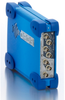
from OROS
OR34 is the compact real-time multi-analyzer that integrates the best of noise & vibration analysis technology in an ultra mobile instrument. OR34 is the synthesis of the ultimate OR3x technology and OROS' wealth of experience in measurement. Designed to offer the essentials in a professional... [See More]
- Sensor Input: Acceleration; Angular Velocity
- Accuracy: 0.01
- Frequency Range: 2000 to 102400
- Number Channels: 2 to 4
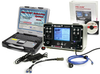
from MTI Instruments Inc.
Portable vibration analysis and engine trim balance instruments and accessories for commercial and military aviation. Designed to swiftly pinpoint engine problems and eliminate avoidable engine removals. Rapid configuration and intuitive user interface make it straightforward and uncomplicated to... [See More]
- Sensor Input: Acceleration; Linear Velocity; Displacement; Angular Velocity
- Device Type: Instrument / Meter
- Frequency Range: 5 to 10000
- Signal Inputs: Voltage; Frequency
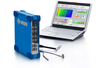
from OROS
OR35 is the portable real-time multi-analyzer that integrates the best of sound & vibration analysis technology in a truly mobile instrument. OR35 is the synthesis of the ultimate OR3x technology and OROS' wealth of experience of measurement. Designed to be the best for field operations, OR35 takes... [See More]
- Sensor Input: Acceleration; Angular Velocity
- Accuracy: 0.01
- Frequency Range: 2000 to 102400
- Number Channels: 8

from MTI Instruments Inc.
Test cell vibration analysis and engine trim balance instruments and accessories for commercial and military aviation gas turbine engines. Designed to quickly isolate engine problems and locate troubles. Rapid configuration and intuitive user interface make it straightforward and uncomplicated to... [See More]
- Sensor Input: Acceleration; Linear Velocity; Displacement; Angular Velocity
- Accuracy: 1.00
- Frequency Range: 5 to 10000
- Number Channels: 8
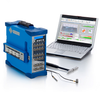
from OROS
OR36 models are intended for advanced needs in acoustic and vibration analysis measurements, for R&D as well as for testing. OR36 is a synthesis of components usually used separately for measurements. OR36 includes an acquisition front-end, with conditioning and sampling, a time domain recorder and... [See More]
- Sensor Input: Acceleration; Angular Velocity
- Accuracy: 0.01
- Frequency Range: 2000 to 102400
- Number Channels: 4 to 16