
Factory / Free Standing Thin Film Equipment
Description
Factory or free-standing thin film equipment is designed to deposit thin layers of material onto a substrate. These machines are capable of handling various materials, including metals, dielectrics, and ceramics, to create thin films with precise thickness and composition. The equipment typically includes features such as process controllers, metrology capabilities, and automated loading systems to ensure efficient and accurate thin film deposition.
Working Principle
Thin film equipment operates by utilizing various deposition techniques such as chemical vapor deposition (CVD), physical vapor deposition (PVD), and ion implantation. In CVD, a precursor gas is introduced into a chamber where it reacts with an energy source to form a thin film coating. PVD involves the evaporation or sputtering of atoms from a source, which then condense onto a substrate. Ion implantation uses a beam of charged atoms directed at a surface, embedding some atoms into the substrate. These processes allow for the precise control of film thickness and composition, making thin film equipment essential for advanced material fabrication.
Applications
Thin film equipment is used in a wide range of applications, including semiconductor manufacturing, where it is crucial for creating integrated circuits. It is also employed in the production of flat panel displays, optical coatings for lenses and mirrors, and magnetic storage devices. In the medical field, thin films are used for coating implants and surgical tools to enhance their biocompatibility and durability.
Advantages over other Thin Film Equipment
Thin film equipment offers several advantages over other types of film deposition methods. For instance, the ability to precisely control film thickness and composition allows for the creation of highly specialized coatings. Additionally, the use of multiple deposition techniques within a single piece of equipment can streamline the manufacturing process, reducing the need for multiple machines and increasing production efficiency.
Limitations
One limitation of thin film equipment is the initial cost, which can be significant due to the complexity and precision required in the manufacturing process. Additionally, the equipment may require specialized maintenance and calibration to ensure optimal performance, which can add to the operational costs.
Considerations
When investing in thin film equipment, it is important to consider factors such as initial costs, which can be high due to the advanced technology involved. Operating expenses should also be evaluated, including energy consumption and maintenance requirements. The durability and accuracy of the equipment are crucial for ensuring consistent production quality, and potential buyers should assess the expected lifespan and replacement costs of key components. Regular maintenance and calibration are necessary to maintain the equipment's performance and extend its operational life.

from Plasma Etch, Inc.
The generous aluminum chamber accommodates a properly sized active processing surface with our standard configurations having as few as 6 or as many as 24 plasma processing levels, each 24 ” by 18. ”. Our oxygen service vacuum pump and booster is equipped with a two point purge system to... [See More]
- Type: Free Standing System
- Applications: Research / Surface Analysis; Printed Circuit Boards
- Process: Plasma Etching and Cleaning
- Materials Processed: Tungsten; Metal; Gallium Arsenide or Compound Semiconductors; Precious Metals
from EBARA Technologies, Inc.
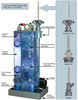
Gas Inlet Devices. Patent gas inlet devices minimize rate of restriction and automatic gas inlet plunger removes restrictions without process interruptions. Second Scrubbing Chamber. Five fine spray, high velocity nozzles ensures effective removal of impurities. First Scrubbing Chamber. Coarse... [See More]
- Type: Free Standing System; Cluster Tool
- Applications: Semiconductors
- Process: Chemical Vapor Deposition
- Materials Processed: Tungsten; Metal; Silicon; Polymer; Nitrides

from Ushio America, Inc.
Strong, deep ultraviolet irradiation neutralizes electric charge on EPROM and Flash memory. Neutralizes electric charge that can be problematic for plasma processing. FEATURES & BENEFITS. UV Charge Erasure. Intense deep ultraviolet irradiation neutralizes electric charge on substrates. This... [See More]
- Type: Free Standing System
from Plasma Etch, Inc.
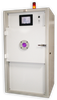
Benefits to you are better adhesion or marking, cleaner parts with less labor and reduced chemical expense by eliminating unwelcome and often expensive chemical waste associated with cleaning and priming. The large all aluminum chamber accommodates a generously sized active processing surface, our... [See More]
- Type: Free Standing System
- Applications: Research / Surface Analysis; Printed Circuit Boards
- Process: Plasma Etching and Cleaning
- Materials Processed: Tungsten; Metal; Gallium Arsenide or Compound Semiconductors; Precious Metals

from EBARA Technologies, Inc.
Ebara's GCR abatement systems cleanly and efficiently remove carbon monoxide and PFC gases from ashing and oxide etch semiconductor waste streams. The standard GCR model targets CO gases using a high temperature oxidation path. PFC's such as CF4 are decomposed using an optional metal catalyst... [See More]
- Type: Free Standing System
- Applications: Semiconductors