
Semiconductor Manufacturing Thin Film Equipment
Description
Semiconductor Manufacturing Thin Film Equipment is designed to deposit extremely thin layers of material onto silicon wafers. These layers are deposited one atomic layer at a time, forming the foundational structures necessary for semiconductor devices. The equipment is crucial in controlling the deposition process to ensure precision and consistency in the formation of these thin films.
Working Principle
The working principle of thin film equipment involves various deposition technologies such as Chemical Vapor Deposition (CVD) and Physical Vapor Deposition (PVD). In CVD, a precursor gas is introduced into a chamber where it reacts with an energy source, typically heat, to form a thin film coating. PVD, on the other hand, involves the evaporation or sputtering of atoms from a source, which then condense onto a substrate to form a thin film. These processes are essential for creating uniform and defect-free films, which are critical as semiconductor devices continue to shrink in size. The equipment also includes advanced monitoring and data analysis tools to optimize the manufacturing conditions.
Applications
Thin film equipment is extensively used in semiconductor manufacturing, where it plays a vital role in the production of computer chips and other electronic components. Specific applications include the manufacturing of flat panel displays, optical coatings, and magnetic storage devices. Additionally, it is used in the production of cutting tools, wear components, and in various research and surface analysis applications.
Advantages over other Thin Film Equipment
One of the advantages of semiconductor manufacturing thin film equipment is its ability to deposit films with high precision and uniformity, which is crucial for the miniaturization of semiconductor devices. The equipment's capability to handle multiple processes simultaneously or sequentially enhances its efficiency and versatility compared to other thin film equipment.
Limitations
A specific limitation of thin film equipment is the complexity and cost associated with maintaining the high precision and control required for semiconductor manufacturing. The equipment requires careful calibration and monitoring to ensure optimal performance, which can be resource-intensive.
Considerations
When considering thin film equipment for semiconductor manufacturing, several factors should be taken into account. Initial costs can be significant due to the advanced technology and precision required. Operating expenses are also a consideration, as the equipment requires regular maintenance and calibration to maintain accuracy. Durability and the ability to handle high throughput are important for long-term use, while replacement and maintenance costs should be factored into the overall investment.
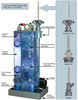
from EBARA Technologies, Inc.
Gas Inlet Devices. Patent gas inlet devices minimize rate of restriction and automatic gas inlet plunger removes restrictions without process interruptions. Second Scrubbing Chamber. Five fine spray, high velocity nozzles ensures effective removal of impurities. First Scrubbing Chamber. Coarse... [See More]
- Applications: Semiconductors
- Process: Chemical Vapor Deposition
- Type: Free Standing System; Cluster Tool
- Materials Processed: Tungsten; Metal; Silicon; Polymer; Nitrides

from Plasma Etch, Inc.
As in all Plasma Etch systems a capacitive parallel plate design is used for the most effective plasma generation. Competitive units with glass/quartz barrel chambers cannot penetrate the vacuum containment vessel and therefore are restricted to inductive coupling using an RF coil wrapped around the... [See More]
- Applications: MEMS; Photovoltaic or solar cell; Research / Surface Analysis; Semiconductors; Medical; Printed Circuit Boards
- Process: Plasma Etching and Cleaning
- Type: Laboratory or Benchtop
- Materials Processed: Tungsten; Metal; Gallium Arsenide or Compound Semiconductors; Precious Metals

from Technic, Inc.
Available for a wide range of continuous processing applications, Technic equipment and chemistry is widely used throughout the industry. Technic ’s Reel-to-Reel Plating Systems offer precise engineering, quality construction and some of the most advanced cell designs and configurations... [See More]
- Applications: Semiconductors; Electronics, Reel Packaging Strip, Chip Carrier Strips, Reel Connectors

from Sunstone Engineering
Seam sealers are used for lid placement and seam sealing applications to encase electronic components such as crystal devices, MEMS, sensors, optical devices, and other optoelectronic packaging applications. Similar to our other welding products, our seam sealer systems deliver an electric current... [See More]
- Applications: Semiconductors
- Type: Seam Sealer Systems

from EBARA Technologies, Inc.
Ebara's GCR abatement systems cleanly and efficiently remove carbon monoxide and PFC gases from ashing and oxide etch semiconductor waste streams. The standard GCR model targets CO gases using a high temperature oxidation path. PFC's such as CF4 are decomposed using an optional metal catalyst... [See More]
- Applications: Semiconductors
- Type: Free Standing System

from Plasma Etch, Inc.
This system is made for smaller production facilities, R &D facilities and universities. The system features an implosion proof 6 ” w x 6 ” d x 4 ” h Rectangular welded Aluminum Vacuum Chamber and a direct powered RF electrode. Applications include medical devices, solar cells,... [See More]
- Applications: MEMS; Photovoltaic or solar cell; Research / Surface Analysis; Semiconductors; Medical; Printed Circuit Boards
- Process: Plasma Etching and Cleaning
- Type: Laboratory or Benchtop
- Materials Processed: Tungsten; Metal; Gallium Arsenide or Compound Semiconductors; Precious Metals

from Technic, Inc.
Technic's patented method of electroplating small components such as electronic connectors, discs, pins and SMT chip capacitors and chip resistors. [See More]
- Applications: Semiconductors; Electronic connectors, Contact Pins, Chip Capacitors, Chip resistors
from Plasma Etch, Inc.
This system is made for smaller production facilities, R &D facilities and universities. The system features an implosion proof 8 ” w x 8 ” d x 4 ” h Rectangular welded Aluminum Vacuum Chamber and a direct powered RF electrode. Applications include medical devices, solar cells,... [See More]
- Applications: MEMS; Photovoltaic or solar cell; Research / Surface Analysis; Semiconductors; Medical; Printed Circuit Boards
- Process: Plasma Etching and Cleaning
- Type: Laboratory or Benchtop
- Materials Processed: Tungsten; Metal; Gallium Arsenide or Compound Semiconductors; Precious Metals

from Technic, Inc.
SBE Systems is available in semiautomatic and fully automatic. The dual hoist system show here with consists of six nickel stations, dragout, cascade rinse, six tin stations, dragout and cascade rinse. In both automatic and semi-automatic SBE systems, the hoist moves a flight bar holding two SBE... [See More]
- Applications: Semiconductors; Electronic connectors, Contact Pins, Chip Capacitors, Chip resistors