
Structured Text (ST) Programmable Logic Controllers (PLC)
Last Updated: January 31, 2025
Description
Structured Text (ST) is a high-level textual programming language used for programmable logic controllers (PLCs). It is designed to express the behavior of functions, function blocks, and programs. ST is part of the IEC 61131-3 standard, which specifies a suite of programming languages for PLCs. The language is similar in syntax to traditional programming languages like Pascal and C, allowing for the creation of complex expressions, conditional statements, and iterative processes.
Working Principle
Structured Text operates by allowing engineers to write code in a format that is similar to high-level programming languages. This includes the use of standard programming constructs such as loops, conditionals, and variable assignments. The language is particularly useful for implementing complex algorithms and control logic that would be cumbersome to express in graphical languages like Ladder Diagram (LD). ST's high-level nature makes it suitable for tasks that require precise control and complex decision-making processes, enhancing the flexibility and functionality of PLCs.
Applications
Structured Text is often used in projects that require complex algorithmic control. For example, it is suitable for applications in process control industries where intricate calculations and logic are necessary. Specific examples include advanced motion control systems, batch processing in chemical plants, and complex HVAC systems where precise environmental control is required.
Advantages over other Programmable Logic Controllers (PLC)
One of the main advantages of using Structured Text over other PLC programming languages is its similarity to traditional high-level programming languages, which makes it easier for software developers to learn and use. This familiarity allows for more efficient coding and debugging processes. Additionally, ST is particularly advantageous in scenarios that require complex mathematical computations and algorithmic logic, which can be more challenging to implement using graphical languages like Ladder Diagram.
Limitations
Structured Text can be less intuitive for those who are accustomed to graphical programming languages, as it requires a deeper understanding of programming concepts. Additionally, because it is a textual language, it may not be as visually intuitive as graphical languages for representing simple control logic, which can make it harder to visualize the flow of control in a program.
Considerations
When considering the use of Structured Text for PLC programming, it is important to evaluate the initial costs and operating expenses associated with training personnel to use the language effectively. While ST can offer high accuracy and flexibility, the complexity of the language may lead to increased development time and maintenance costs if the team is not adequately trained. Additionally, the durability and reliability of the system should be assessed, as the complexity of ST programs can introduce potential for errors if not carefully managed.
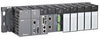
from Delta Electronics (Americas)
Highly integrated software ISPSoft: Graphical Interface with 5 programming languages. Enhanced flexibility: Max. 100m between 2 local extension racks. Improved maintainability: Hot-swapping function keeps the system running [See More]
- Program Languages: IEC61131-3; Sequential Function Chart; Function Block Diagram; Ladder Diagram; Structured Text; Instruction List
- Inputs: 0
- Total Points: 4352
- Outputs: 0
from STW Technic
Designed for harsh environments, freely programmable [See More]
- Program Languages: IEC61131-3; Sequential Function Chart; Function Block Diagram; Ladder Diagram; Structured Text; Instruction List; Relay Ladder Logic; Flow Chart; C Programming Language
- Inputs: 24
- Total Points: 36
- Outputs: 12
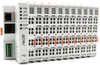
from Shenyang Vhandy Technology Co., Ltd.
GCAN-PLC series. GCAN-PLC-400: 1*CAN+1*Ethernet+1*RS232 (or RS485). CPU frequency: 168M. Program storage: 16M. Data storage: 512K. GCAN-PLC-510: 1*CAN+1*Ethernet+1*RS232 (or RS485). CPU frequency: 400M. Program storage: 32M. Data storage: 16M. GCAN-PLC-511: 2*CAN+1*Ethernet+1*RS232+1*RS485. CPU... [See More]
- Program Languages: Sequential Function Chart; Function Block Diagram; Ladder Diagram; Structured Text; Instruction List
- Outputs: 64
- Inputs: 64
- Computer Interface Options: CAN, Ethernet, RS232/485, Follow ISO 11898, support CANopen/Modbus RTU/Modsbus TCP, can be used as master or slave station
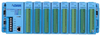
from OMEGA Engineering, Inc.
The ADAM-5510KW series is designed to monitor and control processes through multi-channel I/O modules. Each system is capable of handling up to 4 or 8 I/O modules for channel capacities up to 128 I/O points. Depending on the type and number of I/O points a system can be configured to meet your... [See More]
- Program Languages: IEC61131-3; Sequential Function Chart; Function Block Diagram; Ladder Diagram; Structured Text; Instruction List
- Input: DC Input (optional feature); AC Input (optional feature); Thermocouple Input (optional feature); RTD Input (optional feature); Frequency or Pulse (optional feature)
- Total Points: 128
- Output: DC Output (optional feature); Relay Output (optional feature); Analog Output (optional feature)

from Delta Electronics (Americas)
The Delta Compact Modular Mid-range PLC AS Series is a high performance multi-purpose controller designed for all kinds of automated equipment. It features Delta's self-developed 32-bit SoC CPUs for enhanced execution speed (40 k steps/ms) and supports up to 32 extension modules or up to 1,024... [See More]
- Program Languages: IEC61131-3; Sequential Function Chart; Ladder Diagram; Structured Text; CFC
- Inputs: 16
- Total Points: 32
- Outputs: 16
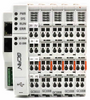
from Shenyang Vhandy Technology Co., Ltd.
GCAN-PLC series. GCAN-PLC-400: 1*CAN+1*Ethernet+1*RS232 (or RS485). CPU frequency: 168M. Program storage: 16M. Data storage: 512K. GCAN-PLC-510: 1*CAN+1*Ethernet+1*RS232 (or RS485). CPU frequency: 400M. Program storage: 32M. Data storage: 16M. GCAN-PLC-511: 2*CAN+1*Ethernet+1*RS232+1*RS485. CPU... [See More]
- Program Languages: Sequential Function Chart; Function Block Diagram; Ladder Diagram; Structured Text; Instruction List
- Outputs: 64
- Inputs: 64
- Computer Interface Options: CAN, Ethernet, RS232/485, Follow ISO 11898, support CANopen/Modbus RTU/Modsbus TCP, can be used as master or slave station

from Shenyang Vhandy Technology Co., Ltd.
GCAN-PLC series. GCAN-PLC-400: 1*CAN+1*Ethernet+1*RS232 (or RS485). CPU frequency: 168M. Program storage: 16M. Data storage: 512K. GCAN-PLC-510: 1*CAN+1*Ethernet+1*RS232 (or RS485). CPU frequency: 400M. Program storage: 32M. Data storage: 16M. GCAN-PLC-511: 2*CAN+1*Ethernet+1*RS232+1*RS485. CPU... [See More]
- Program Languages: Sequential Function Chart; Function Block Diagram; Ladder Diagram; Structured Text; Instruction List
- Outputs: 64
- Inputs: 64
- Computer Interface Options: CAN, Ethernet, RS232/485, Follow ISO 11898, support CANopen/Modbus RTU/Modsbus TCP, can be used as master or slave station

from Shenyang Vhandy Technology Co., Ltd.
GCAN-PLC series. GCAN-PLC-400: 1*CAN+1*Ethernet+1*RS232 (or RS485). CPU frequency: 168M. Program storage: 16M. Data storage: 512K. GCAN-PLC-510: 1*CAN+1*Ethernet+1*RS232 (or RS485). CPU frequency: 400M. Program storage: 32M. Data storage: 16M. GCAN-PLC-511: 2*CAN+1*Ethernet+1*RS232+1*RS485. CPU... [See More]
- Program Languages: Sequential Function Chart; Function Block Diagram; Ladder Diagram; Structured Text; Instruction List
- Outputs: 64
- Inputs: 64
- Computer Interface Options: CAN, Ethernet, RS232/485, Follow ISO 11898, support CANopen/Modbus RTU/Modsbus TCP, can be used as master or slave station