Ball Joints Information
Last revised: January 6, 2025
Reviewed by: Scott Orlosky, consulting engineer
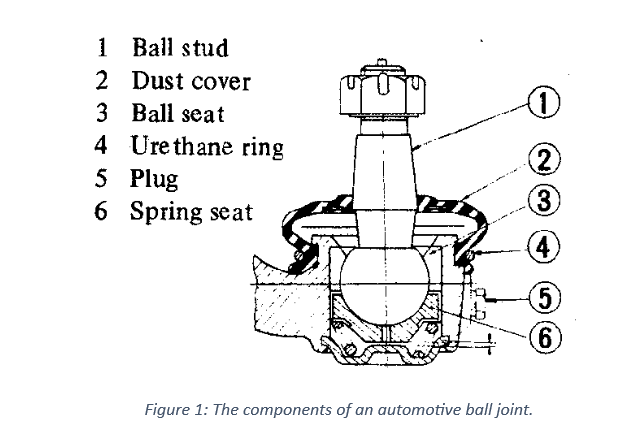
Ball joints are flexible joints consisting of a ball with a protruding stud that has been captured inside an outer housing. They allow simultaneous limited motion in all directions, including rotation as well as angular. Ball joints are frequently used in applications which allow motion on one or two axes but restrict motion on others.
Along these lines, a common use for ball joints is within automobile suspension systems. In this case the vehicle's wheels are allowed to turn and move up and down but are not allowed to move laterally. Other uses include industrial equipment involving repetitive motion.
Types of Ball Joints
- Ball joint swivel
- Plastic ball joints
- 555 ball joints
- Acetal ball joints
- Exhaust ball joints
- Flexible ball joints
- Heavy duty ball joints
- High angle ball joints
- Industrial ball joints
- Inline ball joints
- Large ball joints
- Load bearing ball joints
- Lockable ball joints
- Metric ball joints
- Micro ball joints
- Motorized ball joints
- Pipe ball joints
- PTFE ball joints
- PVC ball joints
- Screw in ball joints
- Small ball joints
- Spherical ball joints
- Spherical rod end ball joints
- Spring loaded ball joints
- Threaded ball joints
- Threaded rod ball joints
Ball Joints FAQs
How do different types of ball joints affect the performance and durability of mechanical systems?
The type of ball joints specified is determined by the performance and durability requirements of the application.
Rzeppa and Weiss Arrangements: These are also known as a type of CV or (Constant Velocity) Ball joint. The Rzeppa design is the “original” CV joint invented in the 1920’s for automobiles. They are available in two similar configurations: the Rzeppa and Weiss types. In the Rzeppa arrangement, all balls are active for each direction of rotation, which can potentially offer more uniform load distribution and smoother operation. In contrast, the Weiss arrangement uses only half the balls, which affects the joint's load distribution and performance under certain conditions.
Fixed versus Plunging Joints: Ball joints can be further classified into fixed and plunging types. Fixed joints allow only articulation, while plunging joints permit both articulation and axial movement (plunging). The choice between these types can affect the system's flexibility and ability to accommodate misalignments or axial movements.
Impact on Performance
Load Distribution: The way the balls are arranged and the type of joint can influence how loads are distributed across the joint. This affects the joint's ability to handle static and dynamic loads, which in turn impacts the overall performance of the mechanical system.
Durability Considerations
Material and Design: The durability of ball joints is also affected by the materials used and the design of the joint. Proper selection and maintenance of these joints are crucial for ensuring long-term reliability and performance.
How does the material of ball joints affect their performance and durability?
Different materials have varying strengths and can handle different levels of stress and load. Materials with higher tensile strength can better withstand the forces applied to the ball joint, potentially improving performance and extending durability.
Materials that are more resistant to wear can prolong the life of the ball joint by reducing the rate of material degradation over time. This is especially true in applications where the joint is subject to frequent movement or high loads.
In environments where exposure to moisture or chemicals is a concern, materials that resist corrosion can prevent deterioration and maintain the integrity of the ball joint over time.
The material properties can affect the friction between the moving parts of the ball joint. Materials that allow for smoother movement can reduce the need for frequent lubrication and maintenance.
What are the key factors affecting the performance of ball joints?
The performance of ball joints is influenced by several key factors, as outlined below:
Type of Ball Joint
The arrangement of balls in the joint affects load distribution. In the Rzeppa arrangement, all balls are active, offering more uniform load distribution and smoother operation. In contrast, the Weiss arrangement uses only half the balls, which might impact performance under certain conditions.
Functionality
Fixed vs. Plunging Joints: Fixed joints allow only articulation, while plunging joints permit both articulation and axial movement. This choice affects the system's flexibility and ability to accommodate misalignments or axial movements.
Load Capacity and Distribution
The way loads are distributed across the joint influences its ability to handle static and dynamic loads, impacting overall performance.
Material Properties
The material of the ball joint affects load capacity, wear resistance, corrosion resistance, and friction. Materials with higher tensile strength and wear resistance can improve performance and durability, while corrosion-resistant materials maintain integrity in harsh environments.
Bearing Design
Bearings play a critical role in managing the interaction between moving parts, ensuring smooth and controlled motion. The selection and design of bearings are critical for achieving desired performance levels.
What role do bearings play in the performance of ball joints?
Bearings are responsible for the performance of ball joints by managing the interaction between moving parts, ensuring that motion is both smooth and controlled. Here are some key insights:
Bearings are indispensable in ensuring that the motion within ball joints is smooth and controlled. This is essential for maintaining the performance and reliability of mechanical systems that utilize ball joints.
Ball bearings, commonly used in ball joints, are effective in handling both radial and axial loads. This capability is vital for the efficient operation of ball joints, as it allows them to manage the forces applied during movement.
The selection and design of bearings are critical for achieving the desired level of performance in systems using ball joints. Properly chosen bearings can enhance the joint's ability to handle loads and maintain smooth operation over time.
What are the advantages of using plunging ball joints in mechanical systems?
The advantages of using plunging ball joints in mechanical systems is their ability to accommodate both articulation and axial movement.
This means they can accommodate misalignments and changes in length within the mechanical system. This flexibility is particularly beneficial in applications where components need to move in multiple directions or where there is a need to absorb axial displacement.
The design of plunging ball joints, with straight or helical tracks, enables them to handle loads effectively while allowing for the necessary movement. This can provides more uniform load distribution across the joint, potentially enhancing the performance and durability of the system.
What are some of the types of loads that ball joints can manage?
Ball joints are versatile components in mechanical systems, capable of handling various types of loads. Here are some insights into the types of loads they can manage:
Radial Loads
Ball joints can handle radial loads, which are forces applied perpendicular to the axis of rotation. This maintains stability and performance in applications where lateral forces are present.
Axial Loads
They are also designed to manage axial loads, which are forces applied along the axis of rotation. This capability is essential for applications where components are subjected to pushing or pulling forces along their length.
Combined Loads
Ball joints are often required to handle combined loads, which involve both radial and axial forces simultaneously. This is particularly important in dynamic applications where the direction and magnitude of forces can vary.
Dynamic and Static Loads
Ball joints have static and dynamic torque capacities, indicating their ability to handle both stationary and moving loads effectively. This is vital for applications that involve rotational motion and varying load conditions.
Moment Loads
In more complex applications, such as robotics, ball joints may need to manage moment loads, which involve rotational forces around an axis.
These capabilities make ball joints suitable for a wide range of applications, from automotive suspensions to robotic arms, where flexibility and load management are critical.
Ball Joints Media Gallery
References
GlobalSpec—Universal Joints and Driveshafts: Analysis, Design, Applications
- ball joint swivel
- plastic ball joints
- angle ball joints
- flexible ball joints
- heavy duty ball joints
- high angle ball joints
- large ball joints
- lockable ball joints
- micro ball joints
- motorized ball joints
- pipe ball joints
- PTFE ball joints
- PVC ball joints
- small ball joints
- spherical ball joints
- spherical rod end ball joints
- spring loaded ball joints
- threaded ball joints