PCI Bus Demystified, Second Edition

Split Transactions

Terminology

The agents participating in a conventional PCI transaction are designated as the initiator and the target. The initiator is the agent that initiates the transaction, the target is the agent selected by the initiator to respond, i.e., the target of the transaction. PCI-X introduces two new terms necessary to identify the agents participating in a Split Transaction. The requester is the agent that first introduces a transaction onto the PCI-X bus. When requesting the transaction, it is the initiator.

The completer is the agent that ultimately completes the transaction. During the initial request phase, the completer is the target. Later, when it is ready to complete the transaction, the completer becomes the initiator and the original requester becomes the target.

Split Response

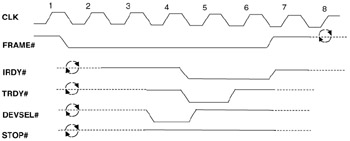
A target that is unable to complete a transaction in a timely manner responds to the requestor with a split response, as illustrated in Figure 12-5. The target claims the transaction normally by asserting DEVSEL#. But, in what would normally be the first data phase with IRDY# and TRDY# asserted, the target negates DEVSEL#. Thus, no data transfer occurs, and the requester is notified that the target will complete the transaction later.


Figure 12-5: Split response.

The target may terminate any transaction except memory write with a Split Response. That is, memory reads, interrupt acknowledge, all I/O and all configuration transactions may be terminated with Split Response. For a read transaction, the target must drive the AD

UNLIMITED FREE
ACCESS
TO THE WORLD'S BEST IDEAS

SUBMIT
Already a GlobalSpec user? Log in.

This is embarrasing...

An error occurred while processing the form. Please try again in a few minutes.

Customize Your GlobalSpec Experience

Category: Business Transaction and Personal Business Software
Finish!
Privacy Policy

This is embarrasing...

An error occurred while processing the form. Please try again in a few minutes.